Atlas · guide
How to read the atlas
What each plate holds, where to start and what each acronym means.
Anatomy of a plate
Every plate follows the same design. Hover over or focus the list to find each part.
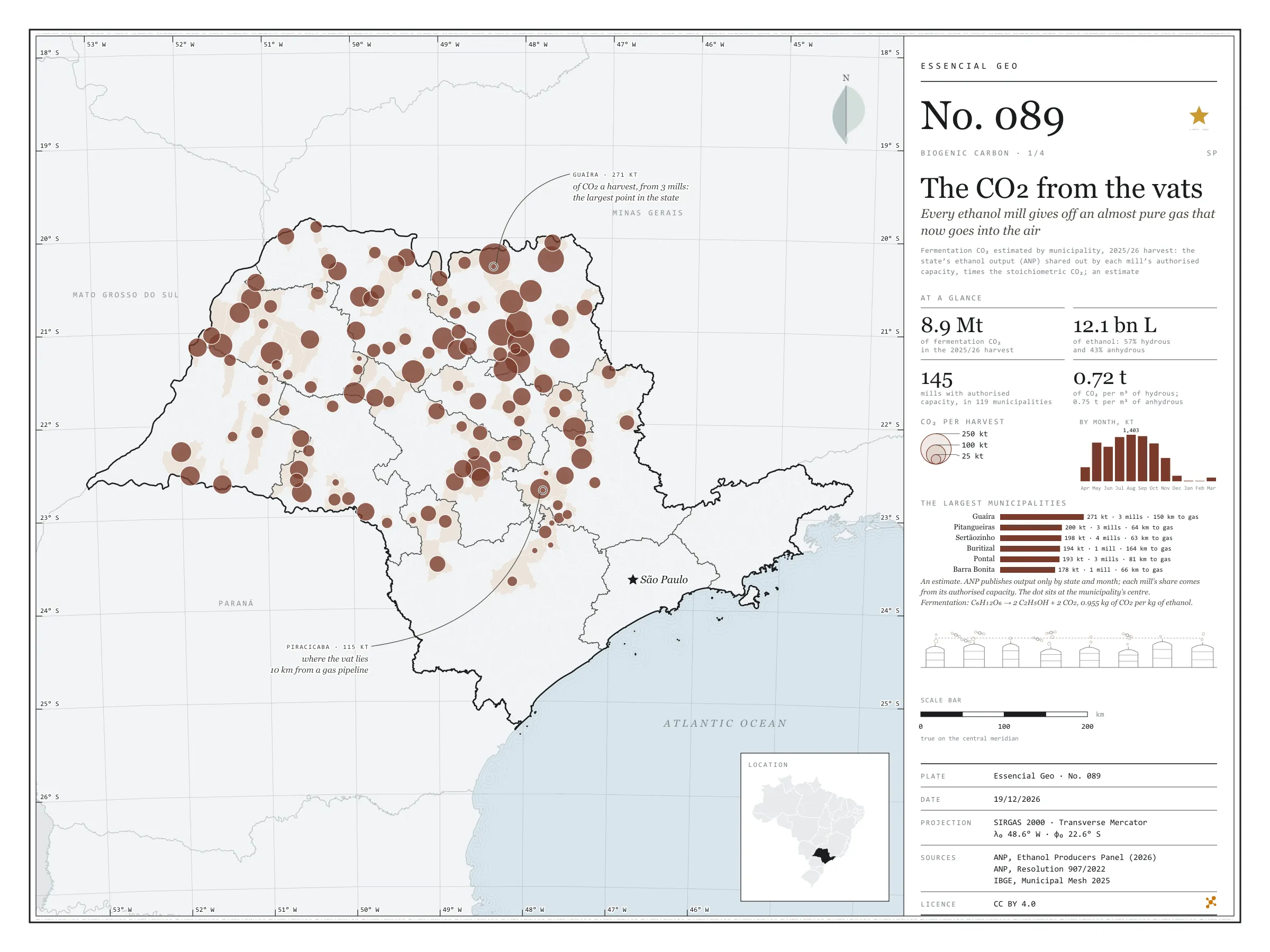
- Number and collection The plate’s number in the atlas and its place in the collection (1/4 is the first of four).
- Title and claim The title names the subject; the italic subtitle says in one sentence what the map shows.
- In figures The three or four numbers that sum the plate up, with unit and time span.
- The map The data over the area. Callouts point to the places the text discusses.
- Legend and charts How to read colours and circles, and the same data as bars or by month.
- Coordinate grid Latitude and longitude along the edge, as on topographic sheets: for orientation and georeferencing.
- North and locator The north arrow and the area within Brazil, in the small map.
- Scale bar The ruler in kilometres, true on the projection’s central meridian.
- Colophon Projection with its parameters, date, sources and licence: all you need to cite and redo it.
- Base map Neighbours, sea and relief in grey: they give context without competing with the data’s colour.
Where to start
Questions the atlas answers, each with its collections in reading order.
-
Where do rubbish and sewage go?
-
How much biomethane could São Paulo make?
See all 9 plates together -
Where does the electricity come from?
-
What does the countryside produce, and what is left over?
- From field to biomethane 5 plates
- Milk, eggs, honey and fish 5 plates
- Manure that feeds the soil 4 plates
-
Where and how do people live?
- People across the land 4 plates
- Favelas and urban communities 4 plates
- Income and rooftop solar 3 plates
-
What goes up in smoke and carbon?
See all 9 plates together -
What is the ground beneath all this like?
- The relief of São Paulo 3 plates
- Water in São Paulo 3 plates
- Campinas Metropolitan Region 4 plates
- Brazil, state by state 27 plates
- The bioeconomy at work 5 plates
Glossary
The acronyms and terms found on the plates. Each plate lists the terms it uses just below the image.
SIRGAS 2000Albers projectionChoropleth mapProportional circlesCensus tractHypsometric tints and hillshadeHarvest yearATRBagasseCane strawVinasseFilter cakeBiogasBiomethaneN1 to N4Nm³DigestateLandfill and open dumpIQRDistributed generationBiogenic CO₂Black liquorWild harvestingSilvicultureCharcoalLand cover and land useRenovaBioCBIOEfficiency scoreSIFFavelas and urban communities2022 CensusRAISMUNICANPPEVSPAMMapBiomasSAPCanaANEEL
Cartography
- SIRGAS 2000 · EPSG:4674
- Brazil’s official geodetic reference system: the “ruler” behind the coordinates of every layer in the atlas. The code EPSG:4674 identifies it in any GIS, and QGIS recognises it when you open the GeoPackage.
- Albers projection
- An equal-area conic projection: it flattens the Earth onto paper without changing areas. A municipality twice as large takes up twice as much paper, which is why it is used to compare quantities across the whole of Brazil.
- Choropleth map
- Each area (municipality, census tract) takes the colour of its value’s class. The colour gives the band, not the total, which is why the plates use rates such as per km², per person or per household.
- Proportional circles
- The circle’s area grows with the quantity. They suit totals (tonnes, plants, MW) that a choropleth would distort, since large municipalities would seem to have more just for being large.
- Census tract
- The smallest collection area of the IBGE Census, a few hundred households each. It is the finest grain at which income, sanitation and housing can be seen without identifying anyone.
- Hypsometric tints and hillshade
- Colours by altitude band, from lowlands to ranges, with a simulated low-angle light that gives the relief its volume.
Sugarcane
- Harvest year
- Cane years are not calendar years: in the Centre-South the harvest runs from April to March; in the Northeast, from September to August. That is why the two regions crush in opposite months.
- ATR (total recoverable sugars)
- Açúcares Totais Recuperáveis, total recoverable sugars: how much sugar can be extracted from each tonne of cane, in kg. It measures cane quality and is the basis of its price.
- Bagasse
- The fibre left after crushing. Burnt in the boilers, it makes the mill’s own steam and electricity; the surplus goes to the grid.
- Cane straw
- Tops and leaves left in the field by mechanised harvesting since cane burning ended. Some can be collected for energy; some must stay to protect the soil.
- Vinasse
- The liquid left by distillation, around ten litres per litre of ethanol, rich in potassium. It goes back to the cane fields as fertiliser and can pass through a digester first.
- Filter cake
- The residue from clarifying cane juice, rich in phosphorus and organic matter: a fertiliser and a biogas feedstock.
Biogas, waste and energy
- Biogas
- The gas from the airless breakdown (anaerobic digestion) of organic waste: manure, vinasse, sewage sludge, rubbish. It is 50% to 70% methane; the rest is mostly CO₂.
- Biomethane
- Biogas upgraded, with most of the CO₂ removed, to ANP’s specification, at which point it replaces natural gas in the pipeline, in industry and in the lorry’s tank.
- N1 to N4 (potential levels)
- CP2B’s four levels: N1 theoretical (all residue generated), N2 technical (after collection), N3 mobilisable (after competing uses and what already becomes biogas) and N4 accessible (after storage and the logistic factor).
- Nm³ (normal cubic metre)
- Gas volume measured at 0 °C and 1 atm, so that measurements made under different conditions can be added and compared.
- Digestate
- What comes out of the digester after the biogas: a liquid with nitrogen, phosphorus and potassium that goes back to the field as fertiliser.
- Landfill and open dump
- A sanitary landfill is an engineered site: sealed ground, leachate and gas drainage. An open dump is tipping in the open air, banned by Brazil’s National Solid Waste Policy. Landfill gas is biogas.
- IQR (landfill quality index)
- CETESB’s Landfill Quality Index: the 0-to-10 score each São Paulo landfill receives every year. Above 7, the landfill is rated adequate.
- Distributed generation
- Small units connected to the distribution grid, close to consumers: micro-generation up to 75 kW and mini-generation above that, up to a few megawatts. The energy becomes credit on the electricity bill.
- Biogenic CO₂
- CO₂ from recently grown biomass, such as that from ethanol fermentation and biogas upgrading: it returns to the air what the plant took shortly before. It can be captured and used.
Forest and land use
- Black liquor
- The dark liquor left when a pulp mill cooks wood to free the fibre. Burnt in the recovery boiler, it returns the process chemicals and makes steam and electricity: the country’s largest source of biomass power after bagasse.
- Wild harvesting (extraction)
- What is gathered from native vegetation without planting it: floodplain açaí, babassu kernels, firewood and charcoal from the forest. IBGE counts it apart from crops (PAM) and from planted forest (silviculture).
- Silviculture · planted forest
- Forest grown like a crop, almost all eucalyptus and pine, for pulp, charcoal, firewood and timber. The “planted” charcoal on the plates comes from here.
- Charcoal
- Wood burnt with little air until it is almost pure carbon; in Brazil it mostly feeds the Minas Gerais steel industry. In 1986 nearly two thirds came from native forest; today almost all comes from planted eucalyptus.
- Land cover and land use
- What covers each patch of ground (forest, pasture, soy, cane, water, town), read from satellite images year by year. The forty-year plates use MapBiomas’ series, 1985 to 2025, summed by municipality.
Policy and regulation
- RenovaBio
- Brazil’s National Biofuels Policy (Law 13,576/2017): it sets yearly decarbonisation targets for fuel distributors, which meet them by buying CBIOs.
- CBIO
- Decarbonisation Credit: one CBIO equals one tonne of CO₂ avoided. A certified plant issues them according to the volume it sells and its efficiency score.
- Efficiency score
- RenovaBio’s energy-environmental efficiency score: how much less the biofuel emits than the fossil fuel it replaces, in g CO₂eq per MJ. The higher it is, the more CBIOs per litre.
- SIF (federal inspection)
- Serviço de Inspeção Federal, the Ministry of Agriculture’s federal inspection: the seal of slaughterhouses and animal-product plants allowed to sell to other states and abroad.
- Favelas and urban communities
- The name IBGE adopted in 2024 in place of “subnormal agglomerations”: low-income housing areas with insecure tenure and incomplete public services.
Data sources
- 2022 Census
- IBGE’s door-to-door count. Results by census tract give residents, age, household-head income, water, sewerage and rubbish.
- RAIS
- The Labour Ministry’s Annual Social Information Report: the formal jobs each establishment declares, with municipality and economic activity (CNAE).
- MUNIC
- IBGE’s Survey of Basic Municipal Information: a questionnaire answered by the town halls themselves on how they govern, rubbish included.
- ANP
- Brazil’s National Agency of Petroleum, Natural Gas and Biofuels: it licenses ethanol and biodiesel plants, tracks filling-station sales and sets the biomethane specification.
- PEVS (IBGE)
- Produção da Extração Vegetal e da Silvicultura, IBGE’s yearly survey of what each municipality harvests from native and planted forest, since 1986.
- PAM (IBGE)
- Produção Agrícola Municipal: area, quantity and value of every crop in every municipality, year by year.
- MapBiomas
- A network of universities, NGOs and companies that classifies land cover across all of Brazil from Landsat images, one map a year since 1985, as open data.
- SAPCana (MAPA)
- The Ministry of Agriculture’s monthly sugar-and-ethanol tracker: cane crushed, sugar and ethanol by state, accumulated from the start of the season on 1 April.
- ANEEL
- Brazil’s National Electricity Agency: it registers every power plant and distributed-generation system, with source, capacity and municipality.