Skip to content
Essencial

No. 054 Energy · biomass Sanitation and biomethane 4/4

Sewage, mains and biomethane

Sludge gas only exists where sewage reaches the plant

Record, downloads and citation
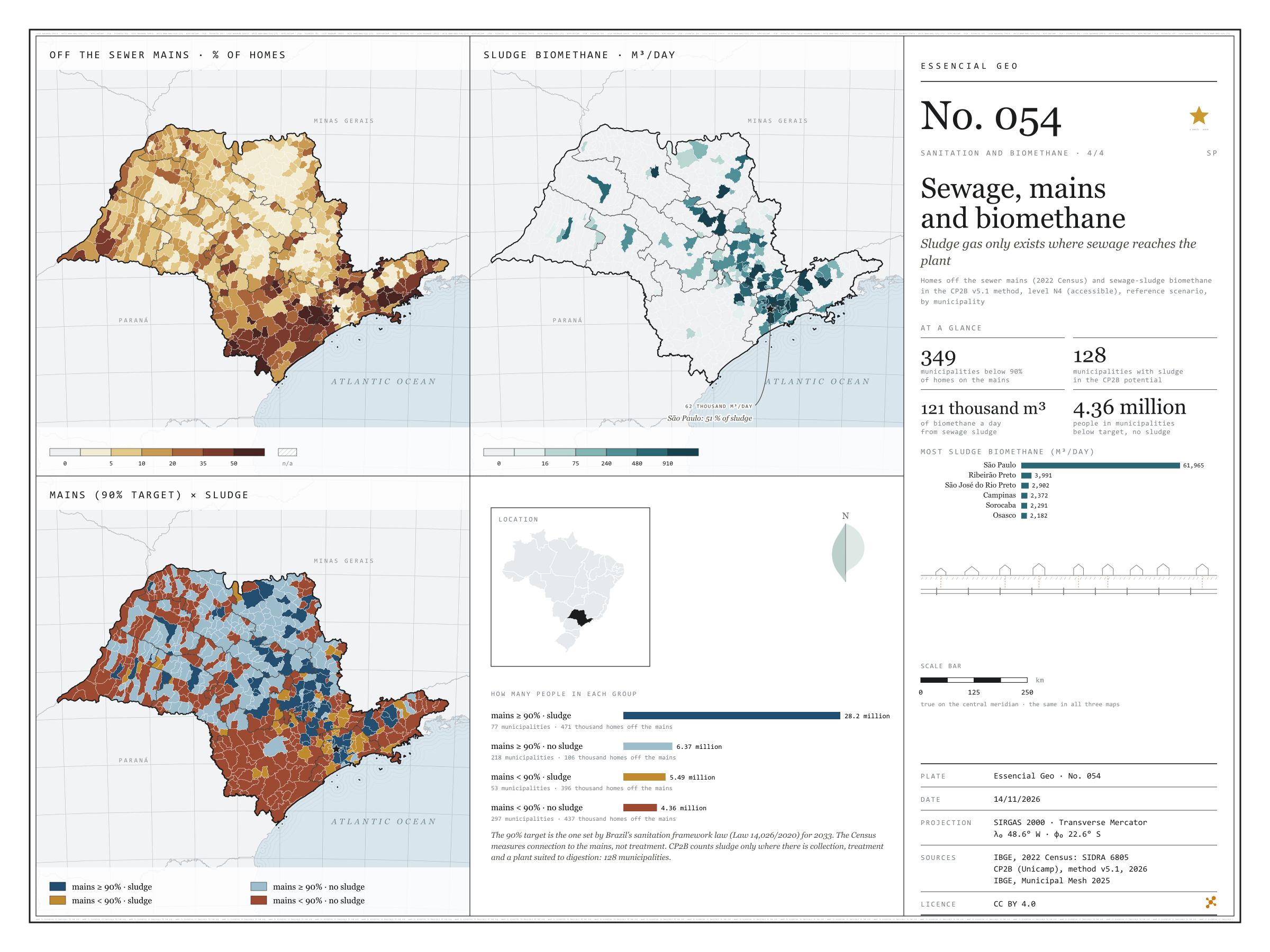
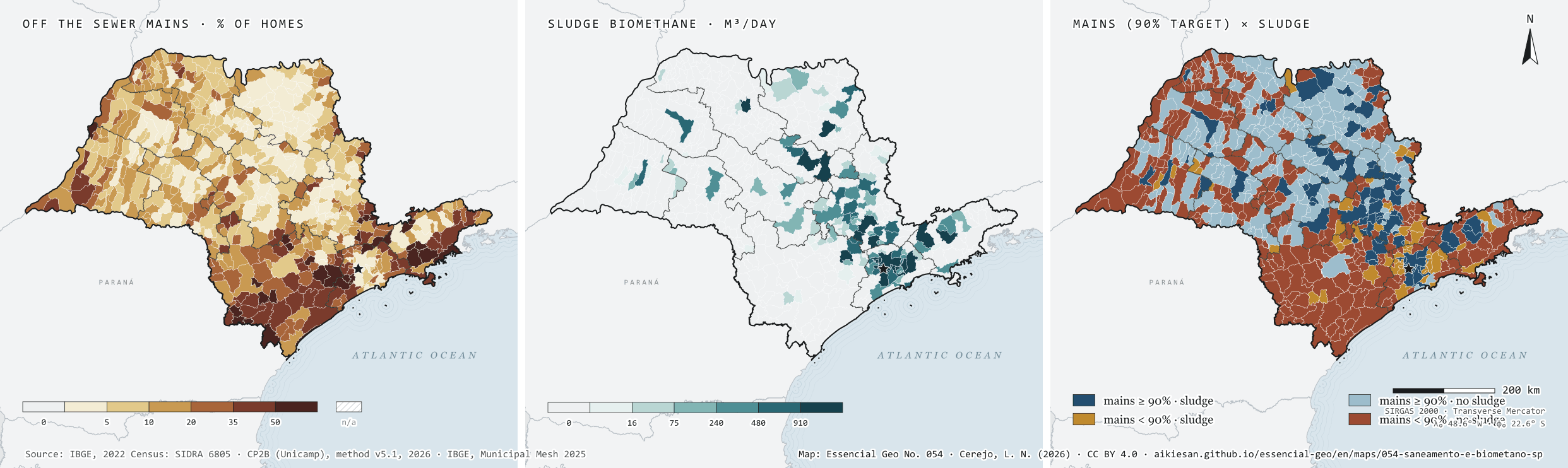
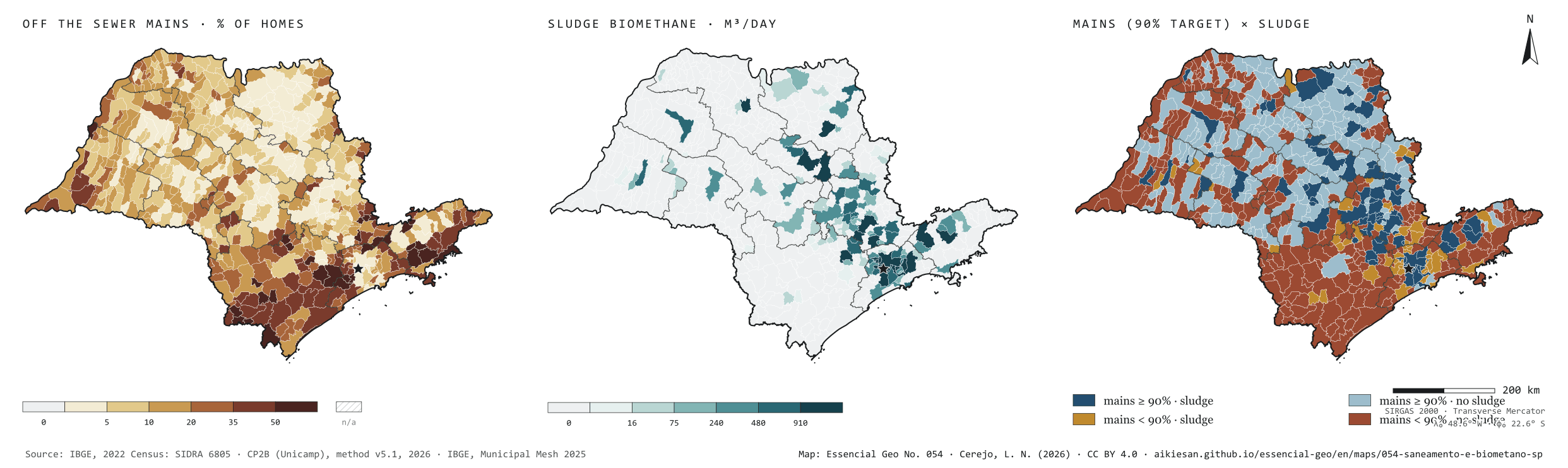
Fig. 054 São Paulo State (SP) EPSG:4674 Source: IBGE, CP2B (Unicamp)

Sludge from sewage plants becomes biomethane, but only where sewage is collected and treated at a plant suited to digestion. Under the CP2B method, that gives São Paulo 121,000 m³ of biomethane a day, in only 128 of its 645 municipalities, and the capital accounts for 51%. Beside it, the 2022 Census: 349 municipalities still have fewer than 90% of households on the mains, the target of the sanitation legal framework for 2033. The crossing separates four groups. 77 municipalities, with 28.2 million people, already pass the target and have sludge; 297, with 4.36 million, are below the target and have no sludge at all, and add up to 437,000 households off the mains. Bringing the mains to those places is the condition for their sewage to count towards the gas. Last plate of the collection “Sanitation and biomethane”.

Technical record · downloads · citation

At a glance

People by mains and sludge group (people)
  • mains ≥ 90% · with sludge 63.5%
  • mains ≥ 90% · no sludge 14.3%
  • mains < 90% · with sludge 12.4%
  • mains < 90% · no sludge 9.8%
Biomethane from sewage sludge

121,403 m³/day

128 municipalities; 61,965 m³/day in the capital

Municipalities below 90% of households on the mains

349 municipalities

9.84 million people

Layers

  • municipios polygon 645 municipalities: people, households, sewage off the mains, uncollected rubbish, biomethane from sludge and rubbish, and crossing group
  • regioes_intermediarias polygon 11 intermediate geographic regions
  • limite_estadual polygon State boundary

Metadata

Extent
São Paulo State (SP)
CRS / Projection
SIRGAS 2000 (EPSG:4674)
EPSG:4674
Software
Node.js · d3-geo · QGIS
Method
Share of households off the sewage mains (SIDRA 6805) and biomethane from sewage sludge under the CP2B v5.1 method, level N4 (accessible), reference scenario, by municipality; municipalities are crossed by the 90% mains target and by whether the potential includes sludge.
Version
v1.0.0
Licence
CC BY 4.0
DOI
being registered on Zenodo

Downloads

Figure to reuse

The map without a frame, with legend, scale, reference system and credit written on it: ready for papers, lectures and slides. In two versions: with the basemap (neighbours and sea) or only the mapped area, on white.

Point a camera at it to open this page.

How to cite

Cerejo, L. N. (2026). Esgoto, rede e biometano: o gás do lodo só existe onde o esgoto chega à estação [Sewage, mains and biomethane: Sludge gas only exists where sewage reaches the plant] (Version 1.0.0) [Data set]. Essencial. https://aikiesan.github.io/essencial-geo/en/maps/054-saneamento-e-biometano-sp/

How to read this plate area, projection, scale, legend and source · 3 terms
1 Area
São Paulo State (SP) The area the plate covers. Outside it, neighbours and sea are drawn in grey, just for orientation.
2 Coordinates and projection
SIRGAS 2000 (EPSG:4674) The layers are in SIRGAS 2000; the drawing’s projection is written in the colophon at the foot of the panel.
3 Scale
Graphic scale bar in the panel The scale bar is true on the central meridian; away from it, measured distances vary a little.
4 Legend and layers
3 layers in the GeoPackage · polygon Read the legend before the map: it tells you whether a colour is a rate or a class, and whether a circle is a total.
5 Sources
IBGE (2022); CP2B (Unicamp) (2026); IBGE (2025) Every figure comes from a public source, with its year. The data sheet gives each one’s address.

Terms on this plate

Biomethane
Biogas upgraded, with most of the CO₂ removed, to ANP’s specification, at which point it replaces natural gas in the pipeline, in industry and in the lorry’s tank.
N1 to N4 (potential levels)
CP2B’s four levels: N1 theoretical (all residue generated), N2 technical (after collection), N3 mobilisable (after competing uses and what already becomes biogas) and N4 accessible (after storage and the logistic factor).
2022 Census
IBGE’s door-to-door count. Results by census tract give residents, age, household-head income, water, sewerage and rubbish.

Download

Layers, table and figures, under CC BY 4.0. Cite with the DOI.

Full record and citation

Method notes · No. 054

Sewage, mains and biomethane in São Paulo’s municipalities

Português · English

Plate No. 054, the last of four in the collection Sanitation and biomethane: the first three show where sewage and rubbish escape; this one asks what that takes away from the biomethane potential.

What the files contain

Layer (GPKG)GeometryContents
municipiospolygon645 municipalities: CD_MUN, NM_MUN, pessoas (people), dppo (occupied permanent private households), esgoto_rede (on mains), esgoto_fora (off mains), pct_esgoto_rede, pct_esgoto_fora, lixo_fora (uncollected rubbish), pct_lixo_fora, biometano_lodo_m3d (sludge), biometano_lixo_m3d (rubbish) and grupo (rede_lodo, rede_sem_lodo, falta_lodo, falta_sem_lodo)
regioes_intermediariaspolygon11 intermediate geographic regions
limite_estadualpolygonstate outline

The municipios layer carries three QGIS styles, one per map (rede_e_lodo is the default). The CSV has the same fields, without geometry.

Method

  1. Sewage: SIDRA table 6805. On the mains means mains or storm drain, or a tank linked to the mains, as on plates 051 and 052.
  2. Biomethane: CP2B (Unicamp) potential, method v5.1, level N4 (accessible), reference scenario, converted from m³ per year to m³ per day. Sewage sludge counts only where there is collection, treatment and a plant suited to anaerobic digestion: hence the 517 municipalities with zero. The biometano_lixo_m3d field also holds the organic fraction of rubbish (434,000 m³/day in the state), which is not mapped.
  3. Groups: mains at 90% of households or more (the target of Law 14,026/2020 for 2033) or below, crossed with sludge above zero or zero.
  4. Uncollected rubbish (lixo_fora): SIDRA table 6892, as on plate 053.

Limitations

  • The Census measures connection to the mains, not treatment; CP2B starts from treatment rates, so a municipality can have high mains coverage and zero sludge.
  • The potential is technical: it says how much gas the sludge could yield, not how much is produced today.
  • Large municipalities below the target that do have sludge include Cotia (65% on the mains), Atibaia (61%), Itapecerica da Serra (64%) and Itanhaém (63%).

View this map’s folder on GitHub

Technical record

Technical record · No. 054

Sewage, mains and biomethane

At a glance

People by mains and sludge group (people)
  • mains ≥ 90% · with sludge 63.5%
  • mains ≥ 90% · no sludge 14.3%
  • mains < 90% · with sludge 12.4%
  • mains < 90% · no sludge 9.8%
Biomethane from sewage sludge

121,403 m³/day

128 municipalities; 61,965 m³/day in the capital

Municipalities below 90% of households on the mains

349 municipalities

9.84 million people

Layers

  • municipios polygon 645 municipalities: people, households, sewage off the mains, uncollected rubbish, biomethane from sludge and rubbish, and crossing group
  • regioes_intermediarias polygon 11 intermediate geographic regions
  • limite_estadual polygon State boundary

Metadata

Extent
São Paulo State (SP)
CRS / Projection
SIRGAS 2000 (EPSG:4674)
EPSG:4674
Software
Node.js · d3-geo · QGIS
Method
Share of households off the sewage mains (SIDRA 6805) and biomethane from sewage sludge under the CP2B v5.1 method, level N4 (accessible), reference scenario, by municipality; municipalities are crossed by the 90% mains target and by whether the potential includes sludge.
Version
v1.0.0
Licence
CC BY 4.0
DOI
being registered on Zenodo

Downloads

Figure to reuse

The map without a frame, with legend, scale, reference system and credit written on it: ready for papers, lectures and slides. In two versions: with the basemap (neighbours and sea) or only the mapped area, on white.

Point a camera at it to open this page.

How to cite

Cerejo, L. N. (2026). Esgoto, rede e biometano: o gás do lodo só existe onde o esgoto chega à estação [Sewage, mains and biomethane: Sludge gas only exists where sewage reaches the plant] (Version 1.0.0) [Data set]. Essencial. https://aikiesan.github.io/essencial-geo/en/maps/054-saneamento-e-biometano-sp/

100%