Eggs
One in five of São Paulo’s eggs comes from Bastos
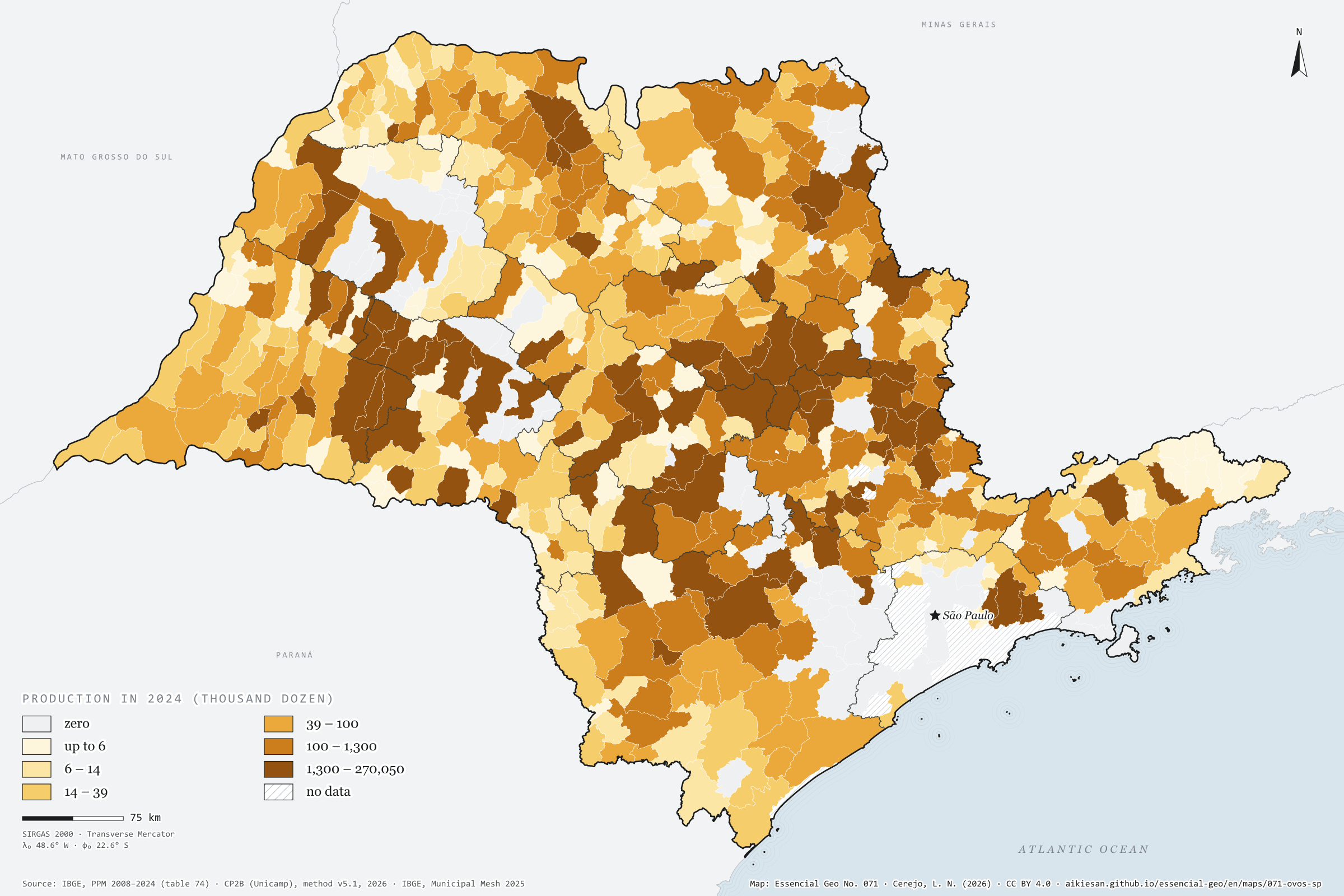
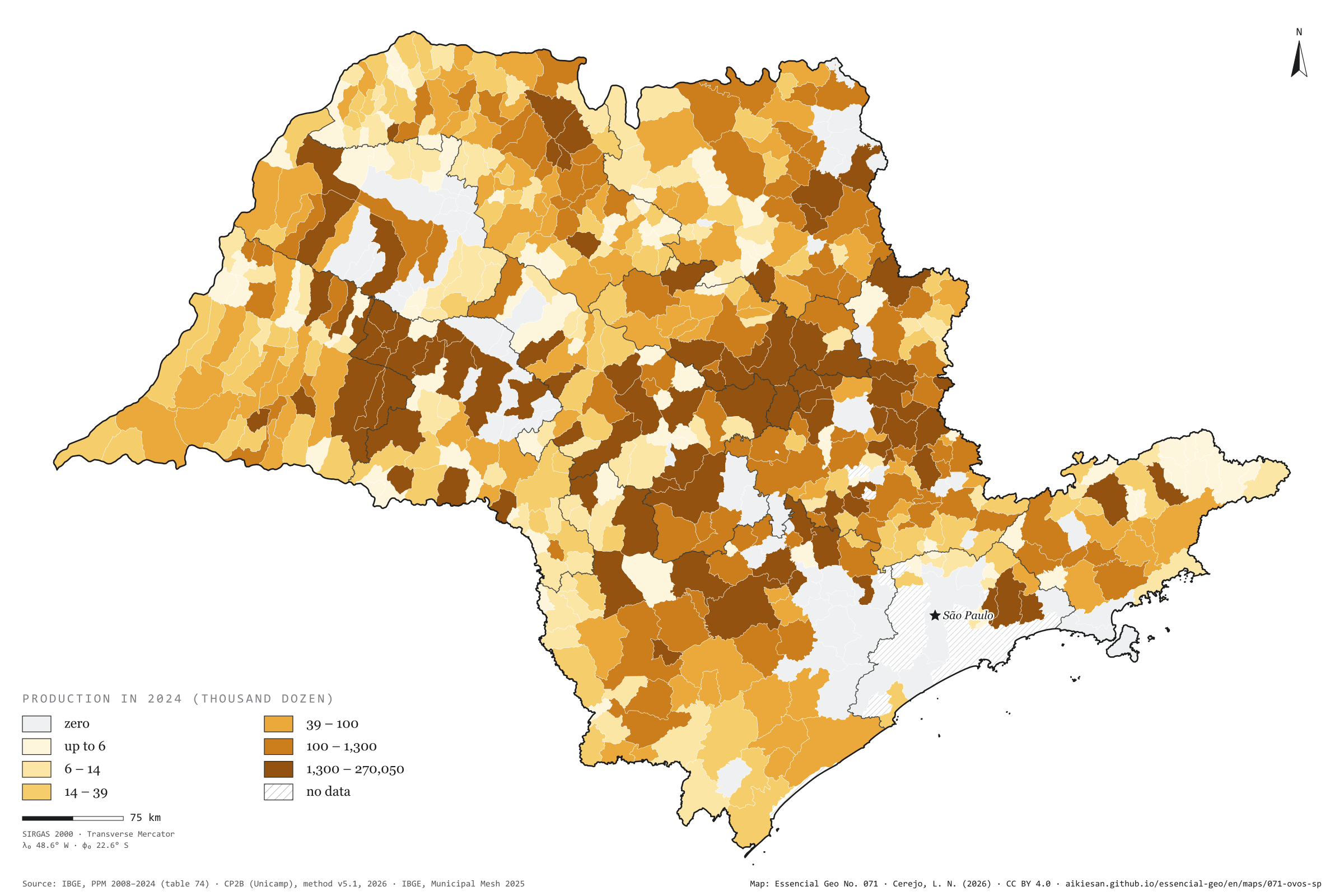
Record, downloads and citationSão Paulo produced 1.27 billion dozen hen eggs in 2024, 52% more than in 2008 and 23.6% of Brazil’s total. Bastos alone, in the Marília region, produced 270 million dozen, one in five of the state’s eggs. With Tupã and its neighbours, the Marília region accounts for 42% of production, and the ten largest municipalities for 54%. Even so, 540 municipalities report some production, and eggs appear across almost the whole map; only Greater São Paulo and the coast lack data. Laying-hen manure is also a residue: by the CP2B method it could yield 296,000 m³ of biomethane a day across the state, 62,600 of them in Bastos. Quail eggs went the other way, falling from 82.8 to 37.3 million dozen. First plate of the collection “Milk, eggs, honey and fish”.
Technical record · downloads · citation
At a glance
1,274,158 thousand dozen
296,316 m³/day
Layers
- municipios polygon 645 municipalities: hen egg production in 2008 and 2024 (thousand dozen), data status in 2024 and laying-hen biomethane
- regioes_intermediarias polygon 11 intermediate geographic regions
- limite_estadual polygon State boundary
Metadata
- Sources
- IBGE — Municipal Livestock Survey (PPM), table 74: animal products (2008 a 2024)
CP2B (Unicamp) — biogas and biomethane potential by municipality, method v5.1 (2026)
IBGE — Municipal Mesh 2025 (2025) - Extent
- São Paulo state (SP)
- CRS / Projection
- SIRGAS 2000 (EPSG:4674)
EPSG:4674 - Software
- Python · GeoPandas · GDAL · QGIS · Node.js · d3-geo
- Method
- Hen egg production from PPM 2024 by municipality in six quantile classes; state series from 2008 to 2024; biomethane potential of laying-hen manure at the accessible level of the CP2B method.
- Version
- v1.0.0
- Licence
- CC BY 4.0
- DOI
- being registered on Zenodo
Downloads
- GPKG Three layers, SIRGAS 2000, with QGIS styles (.gpkg) 18.5 MB
- CSV Hen eggs in 2008 and 2024 and laying-hen biomethane by municipality (.csv) 39 kB
- SVG Vector plate, for printing (.svg) 2.2 MB
- PNG Plate (PNG, 2400 px) (.png) 0.3 MB

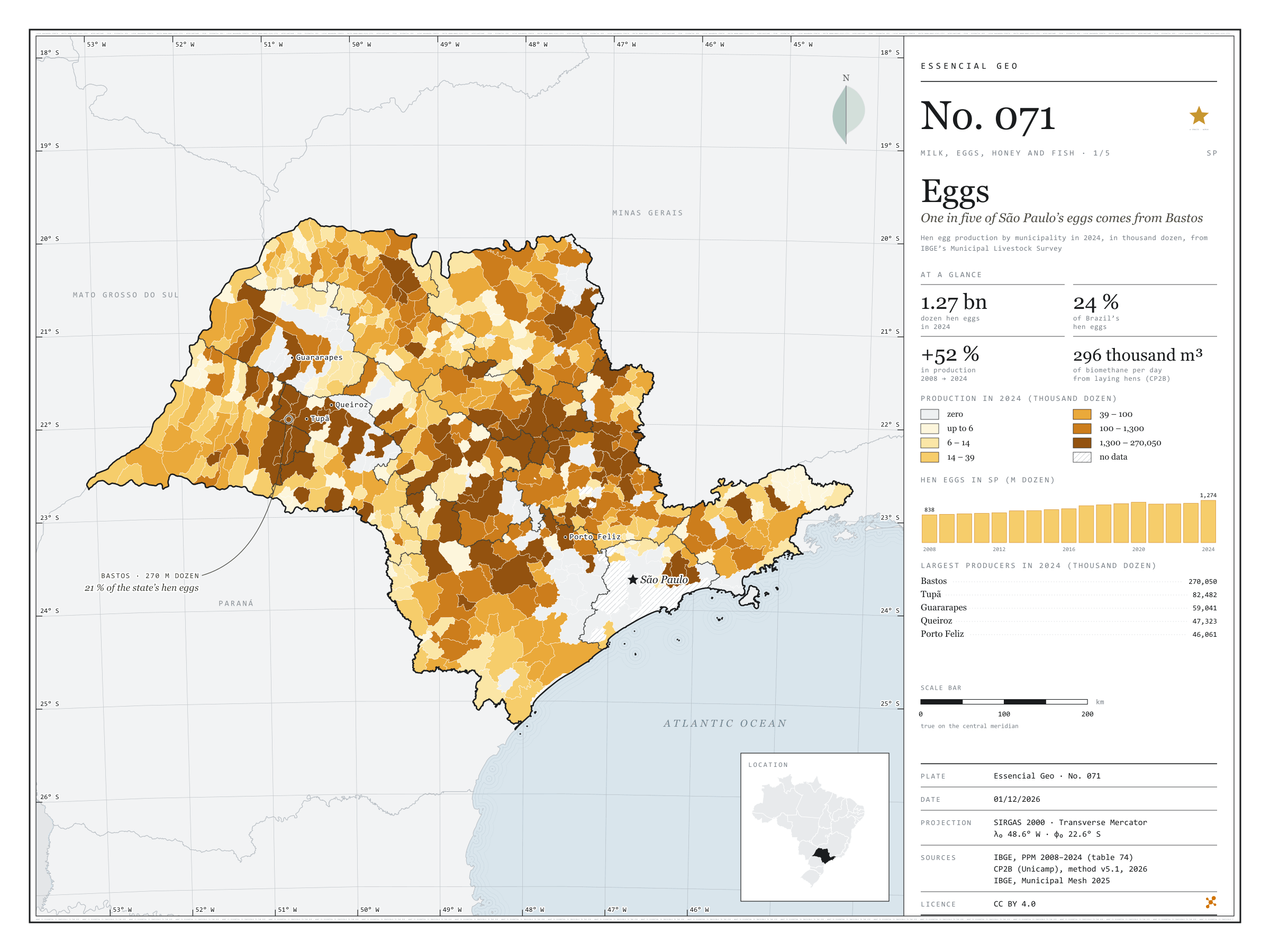
Figure to reuse
The map without a frame, with legend, scale, reference system and credit written on it: ready for papers, lectures and slides. In two versions: with the basemap (neighbours and sea) or only the mapped area, on white.
With basemap (PNG) Without basemap (PNG) QR code (SVG)
Point a camera at it to open this page.
How to cite
CEREJO, Lucas Nakamura. Ovos: um em cada cinco ovos paulistas sai de Bastos. Versão 1.0.0. [S. l.]: Essencial, 2026. Conjunto de dados. Disponível em: https://aikiesan.github.io/essencial-geo/en/maps/071-ovos-sp/. Acesso em: 10 nov. 2026.
Cerejo, L. N. (2026). Ovos: um em cada cinco ovos paulistas sai de Bastos [Eggs: One in five of São Paulo’s eggs comes from Bastos] (Version 1.0.0) [Data set]. Essencial. https://aikiesan.github.io/essencial-geo/en/maps/071-ovos-sp/
@dataset{cerejo2026_ovos_sp,
  author    = {Cerejo, Lucas Nakamura},
  title     = {Ovos: Um em cada cinco ovos paulistas sai de Bastos},
  year      = {2026},
  publisher = {Essencial},
  version   = {1.0.0},
  url       = {https://aikiesan.github.io/essencial-geo/en/maps/071-ovos-sp/},
  language  = {portuguese},
  note      = {English title: Eggs: One in five of São Paulo’s eggs comes from Bastos. Licence CC BY 4.0}
}