Skip to content
Essencial

No. 073 Land use Milk, eggs, honey and fish 3/5

Honey

More than tripled in sixteen years

Record, downloads and citation
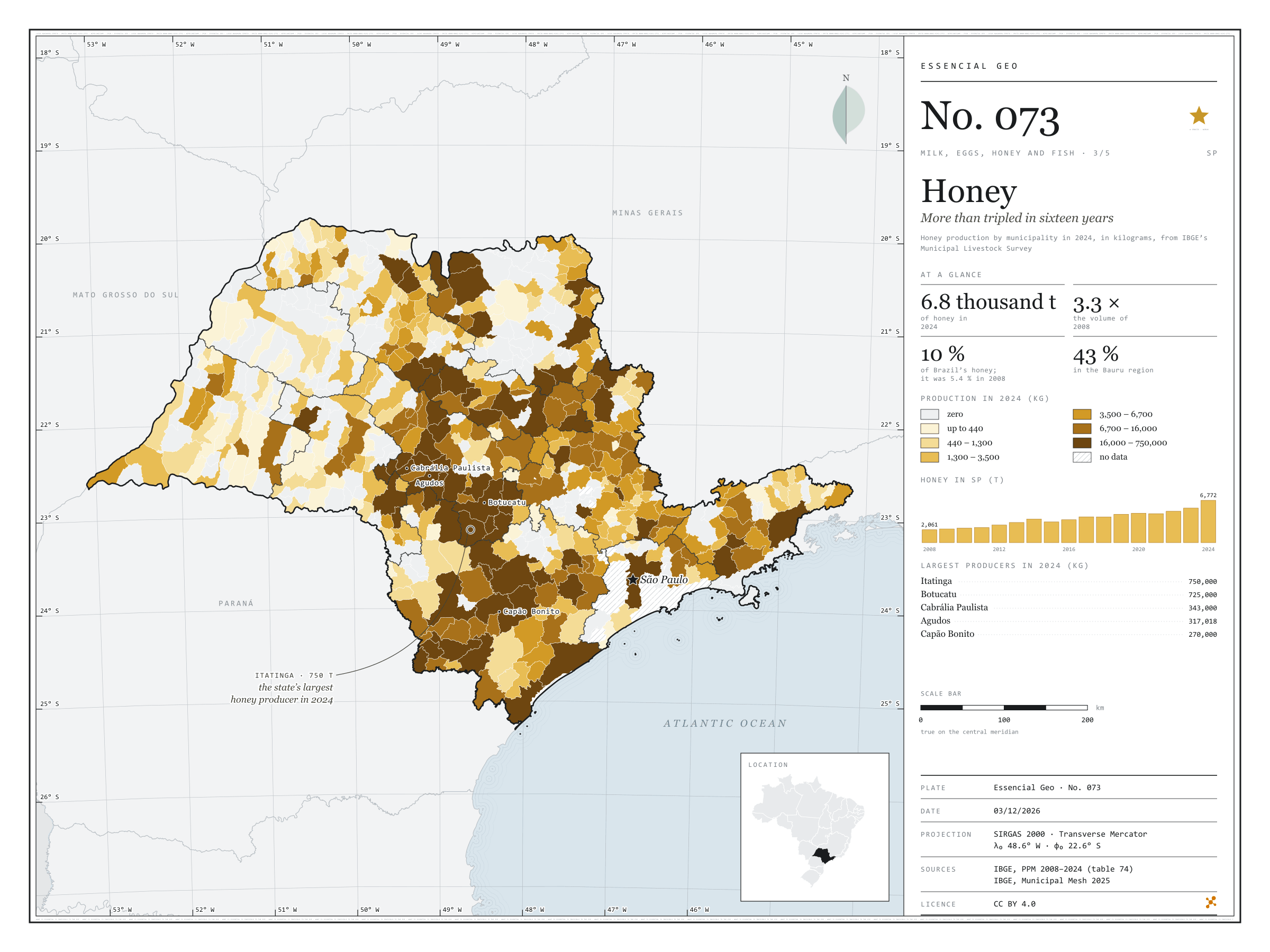
Fig. 073 São Paulo state (SP) EPSG:4674 Source: IBGE

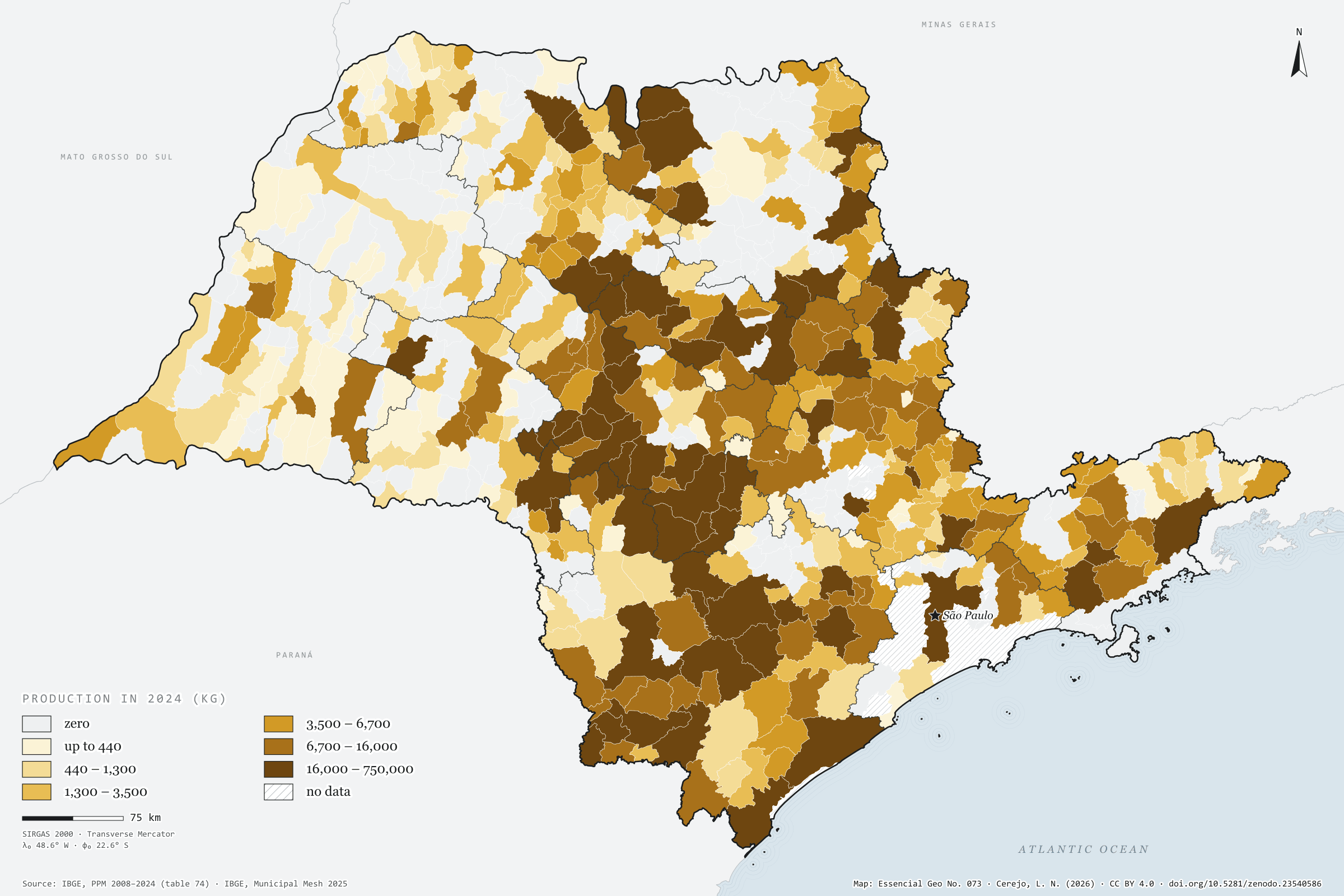
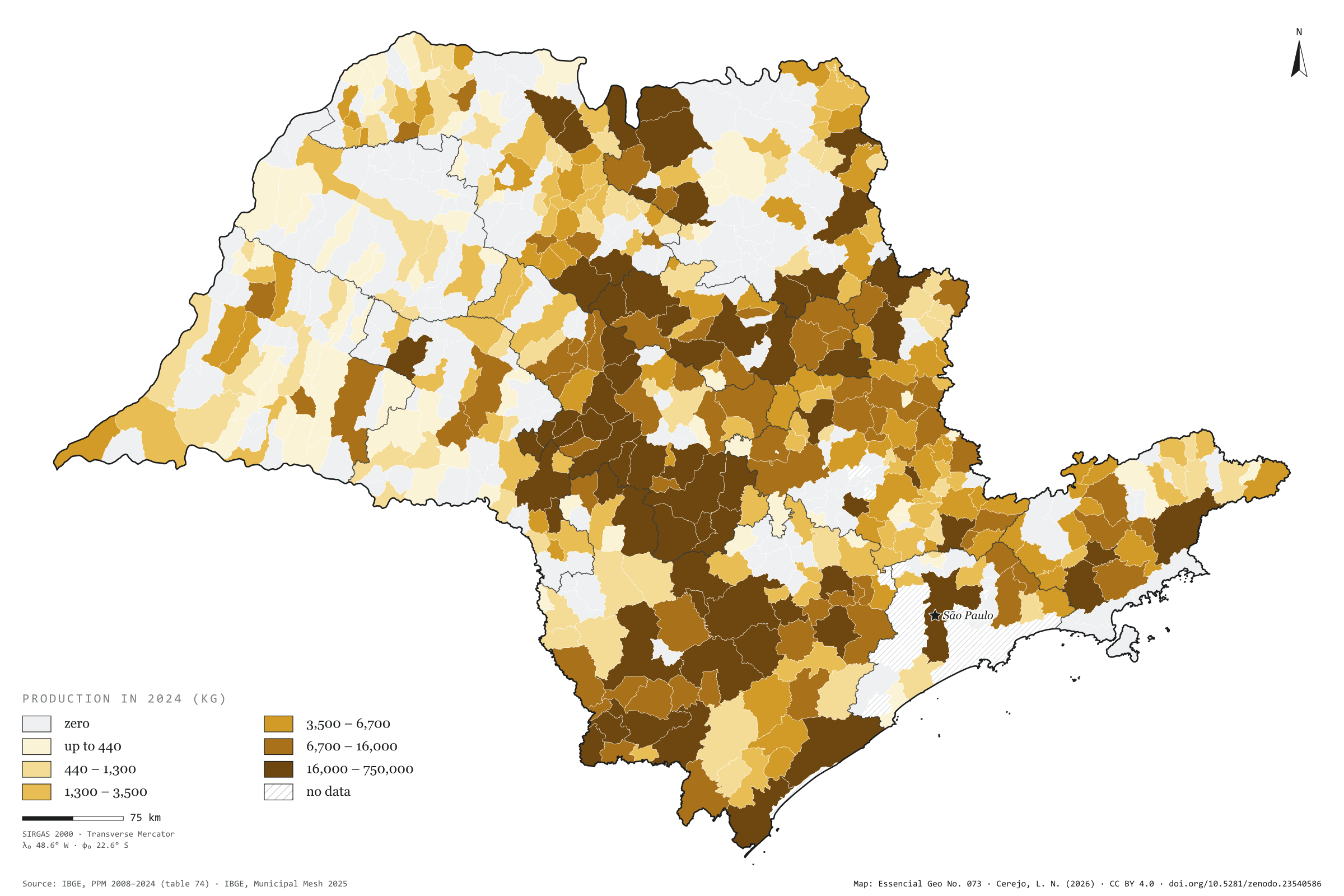
São Paulo produced 6,800 tonnes of honey in 2024, 3.3 times what it produced in 2008. Production grew in almost every year and jumped by 23% from 2023 to 2024 alone. In Brazil the growth was smaller, from 37,800 to 67,300 tonnes, and the state’s share almost doubled, from 5.4% to 10.1%. Honey is concentrated in the centre-south of the state, around Botucatu: the Bauru intermediate region produces 43% of the total. Itatinga, with 750 tonnes, and Botucatu, with 725, add up to 22% of the state’s honey; Cabrália Paulista, Agudos and Capão Bonito follow, and the ten largest produce 49%. The number of producing municipalities is the same in both years, 408: the growth came from those already producing. The west, by contrast, barely shows. Third plate of the collection “Milk, eggs, honey and fish”.

Technical record · downloads · citation

At a glance

Honey in 2024

6,772,329 kg

In 2008 it was 2,061,425 kg; the share of Brazil went from 5.4% to 10.1%

Honey in the Bauru intermediate region

43 %

2,930,210 kg in 2024

Largest producers in 2024 (kg)
  • Itatinga 750,000
  • Botucatu 725,000
  • Cabrália Paulista 343,000
  • Agudos 317,018
  • Capão Bonito 270,000

Layers

  • municipios polygon 645 municipalities: honey production in 2008 and 2024 (kg) and data status in 2024
  • regioes_intermediarias polygon 11 intermediate geographic regions
  • limite_estadual polygon State boundary

Metadata

Extent
São Paulo state (SP)
CRS / Projection
SIRGAS 2000 (EPSG:4674)
EPSG:4674
Software
Python · GeoPandas · GDAL · QGIS · Node.js · d3-geo
Method
Honey production from PPM 2024 by municipality in six quantile classes; state series from 2008 to 2024.
Version
v1.0.0
Licence
CC BY 4.0

Downloads

Figure to reuse

The map without a frame, with legend, scale, reference system and credit written on it: ready for papers, lectures and slides. In two versions: with the basemap (neighbours and sea) or only the mapped area, on white.

Point a camera at it to open this page.

How to cite

Cerejo, L. N. (2026). Mel: mais que triplicou em dezesseis anos [Honey: More than tripled in sixteen years] (Version 1.0.0) [Data set]. Zenodo. https://doi.org/10.5281/zenodo.23540586

How to read this plate area, projection, scale, legend and source
1 Area
São Paulo state (SP) The area the plate covers. Outside it, neighbours and sea are drawn in grey, just for orientation.
2 Coordinates and projection
SIRGAS 2000 (EPSG:4674) The layers are in SIRGAS 2000; the drawing’s projection is written in the colophon at the foot of the panel.
3 Scale
Graphic scale bar in the panel The scale bar is true on the central meridian; away from it, measured distances vary a little.
4 Legend and layers
3 layers in the GeoPackage · polygon Read the legend before the map: it tells you whether a colour is a rate or a class, and whether a circle is a total.
5 Sources
IBGE (2008 a 2024); IBGE (2025) Every figure comes from a public source, with its year. The data sheet gives each one’s address.

Download

Layers, table and figures, under CC BY 4.0. Cite with the DOI.

Full record and citation

Method notes · No. 073

Honey in São Paulo, 2024

Português · English

Plate No. 073, the third of five in the collection Milk, eggs, honey and fish: the animal product that has grown most in the state since 2008.

What the files contain

Layer (GPKG)GeometryContents
municipiospolygon645 municipalities: CD_MUN, NM_MUN, intermediate region, producao_2008 and producao_2024 (kg of honey) and situacao_2024 (valor, zero, nao_disponivel or fora_da_tabela)
regioes_intermediariaspolygon11 intermediate geographic regions
limite_estadualpolygonoutline of the state

The GPKG is zipped and attached to the animal-sp-2026 release. The municipios layer opens in QGIS with the plate’s classes (style producao).

The CSV holds the municipal table, in UTF-8, without geometry. An empty cell means no data; 0 means zero.

Method

  1. Table 74 of the Municipal Livestock Survey on SIDRA: Animal products, product Honey (kilograms), years 2008 to 2024, municipal level, São Paulo state. Brazil’s total, for the state’s share, adds up every municipality in the country in the same table.
  2. 2024 production in six quantile classes of the municipalities with positive production, with limits rounded to two significant figures. The plate’s legend shows the limits in kg.
  3. Data status: zero where IBGE publishes a dash; nao_disponivel where it publishes “X” or “…”; fora_da_tabela where the municipality is missing.

Limitations

  • PPM is an IBGE municipal estimate based on local informants; honey is counted where the hives are according to those informants, and apiaries that move with the flowering may be recorded in a single municipality.
  • Round figures, such as Itatinga’s 750,000 kg and Botucatu’s 725,000 kg, point to estimates, not weighing.
  • 32 municipalities have no data in 2024, almost all in Greater São Paulo and on the coast.

Data licence

Open data from IBGE, free to use with attribution.

View this map’s folder on GitHub

Technical record

Technical record · No. 073

Honey

At a glance

Honey in 2024

6,772,329 kg

In 2008 it was 2,061,425 kg; the share of Brazil went from 5.4% to 10.1%

Honey in the Bauru intermediate region

43 %

2,930,210 kg in 2024

Largest producers in 2024 (kg)
  • Itatinga 750,000
  • Botucatu 725,000
  • Cabrália Paulista 343,000
  • Agudos 317,018
  • Capão Bonito 270,000

Layers

  • municipios polygon 645 municipalities: honey production in 2008 and 2024 (kg) and data status in 2024
  • regioes_intermediarias polygon 11 intermediate geographic regions
  • limite_estadual polygon State boundary

Metadata

Extent
São Paulo state (SP)
CRS / Projection
SIRGAS 2000 (EPSG:4674)
EPSG:4674
Software
Python · GeoPandas · GDAL · QGIS · Node.js · d3-geo
Method
Honey production from PPM 2024 by municipality in six quantile classes; state series from 2008 to 2024.
Version
v1.0.0
Licence
CC BY 4.0

Downloads

Figure to reuse

The map without a frame, with legend, scale, reference system and credit written on it: ready for papers, lectures and slides. In two versions: with the basemap (neighbours and sea) or only the mapped area, on white.

Point a camera at it to open this page.

How to cite

Cerejo, L. N. (2026). Mel: mais que triplicou em dezesseis anos [Honey: More than tripled in sixteen years] (Version 1.0.0) [Data set]. Zenodo. https://doi.org/10.5281/zenodo.23540586

100%