Skip to content
Essencial

No. 076 Energy · biomass The bioeconomy at work 1/5

The bioeconomy in jobs

One formal job in fifteen comes from biomass

Record, downloads and citation
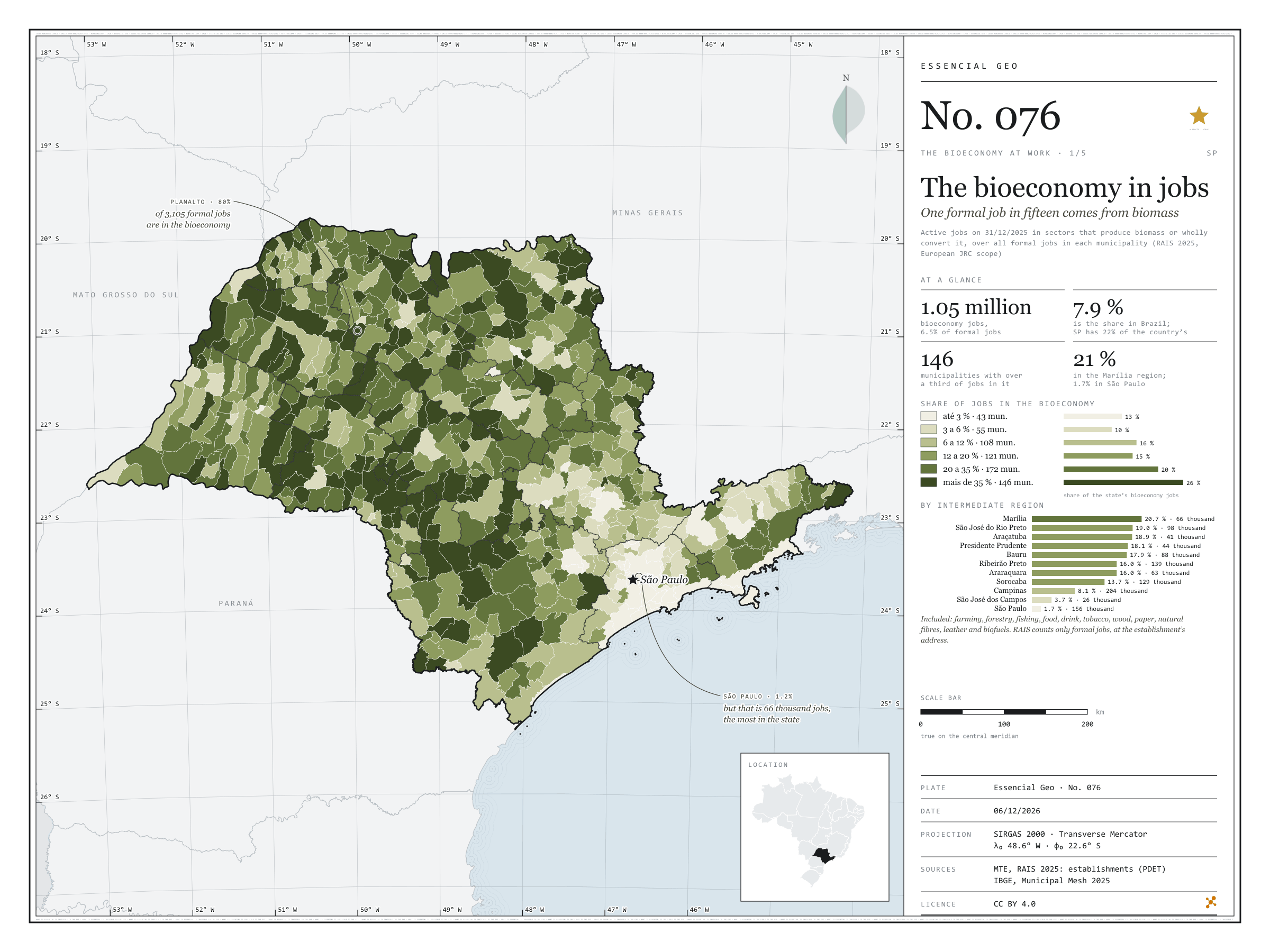
Fig. 076 São Paulo State (SP) EPSG:4674 Source: MTE/PDET, JRC (European Commission), IBGE

On 31 December 2025, 1.05 million formal jobs in São Paulo were in the bioeconomy: in farming, fishing and forestry, and in the industries that wholly convert biomass, such as food, drink, wood, paper, natural fibres, leather and biofuels. This is the scope the European Commission’s Joint Research Centre (JRC) uses to measure the European Union’s bioeconomy. They are 6.5% of the state’s 16.16 million jobs, below Brazil’s 7.9%, yet SP holds 22% of the country’s formal bioeconomy. The share grows westwards: 20.7% in the Marília region, 1.7% in the São Paulo region. In 146 municipalities over 35% of formal jobs come from biomass; in Planalto, 80%. The capital has the largest number, 66,000 jobs, but only 1.2% of its own. First plate of the collection “The bioeconomy at work”.

Technical record · downloads · citation

At a glance

Bioeconomy jobs by the bioeconomy’s share of the municipality’s jobs (jobs)
  • up to 3% 12.6%
  • 3 to 6% 10.4%
  • 6 to 12% 15.8%
  • 12 to 20% 14.9%
  • 20 to 35% 20.5%
  • over 35% 25.9%
Formal jobs in the bioeconomy

6.5 %

1.05 million jobs; Brazil, 7.9%

SP’s share of Brazil’s formal bioeconomy

22 %

of 4.74 million jobs

Layers

  • municipios polygon 645 municipalities: jobs, bioeconomy jobs by segment, share and location quotient, organic-waste-generating industries, waste and sewage, CP2B biomethane potential and population
  • regioes_intermediarias polygon 11 intermediate geographic regions
  • limite_estadual polygon State boundary

Metadata

Extent
São Paulo State (SP)
CRS / Projection
SIRGAS 2000 (EPSG:4674)
EPSG:4674
Software
Node.js · d3-geo · QGIS
Method
Active jobs on 31/12/2025 in the bioeconomy’s CNAE subclasses (farming, fishing and forestry; food, drink and tobacco; wood, paper and wooden furniture; natural fibres and leather; biofuels), within the European JRC scope, over all active jobs in each municipality, in six classes.
Version
v1.0.0
Licence
CC BY 4.0
DOI
being registered on Zenodo

Downloads

Figure to reuse

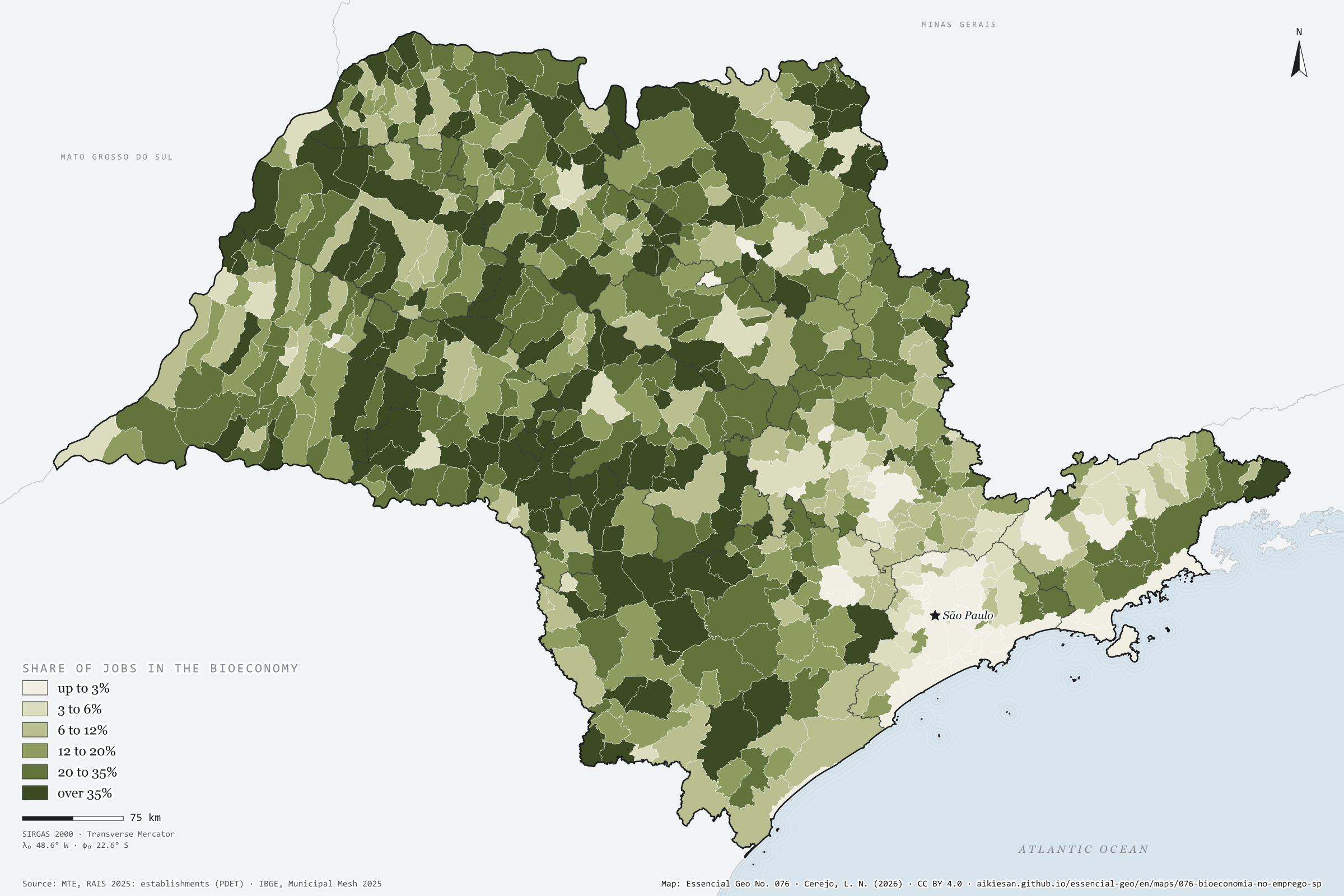
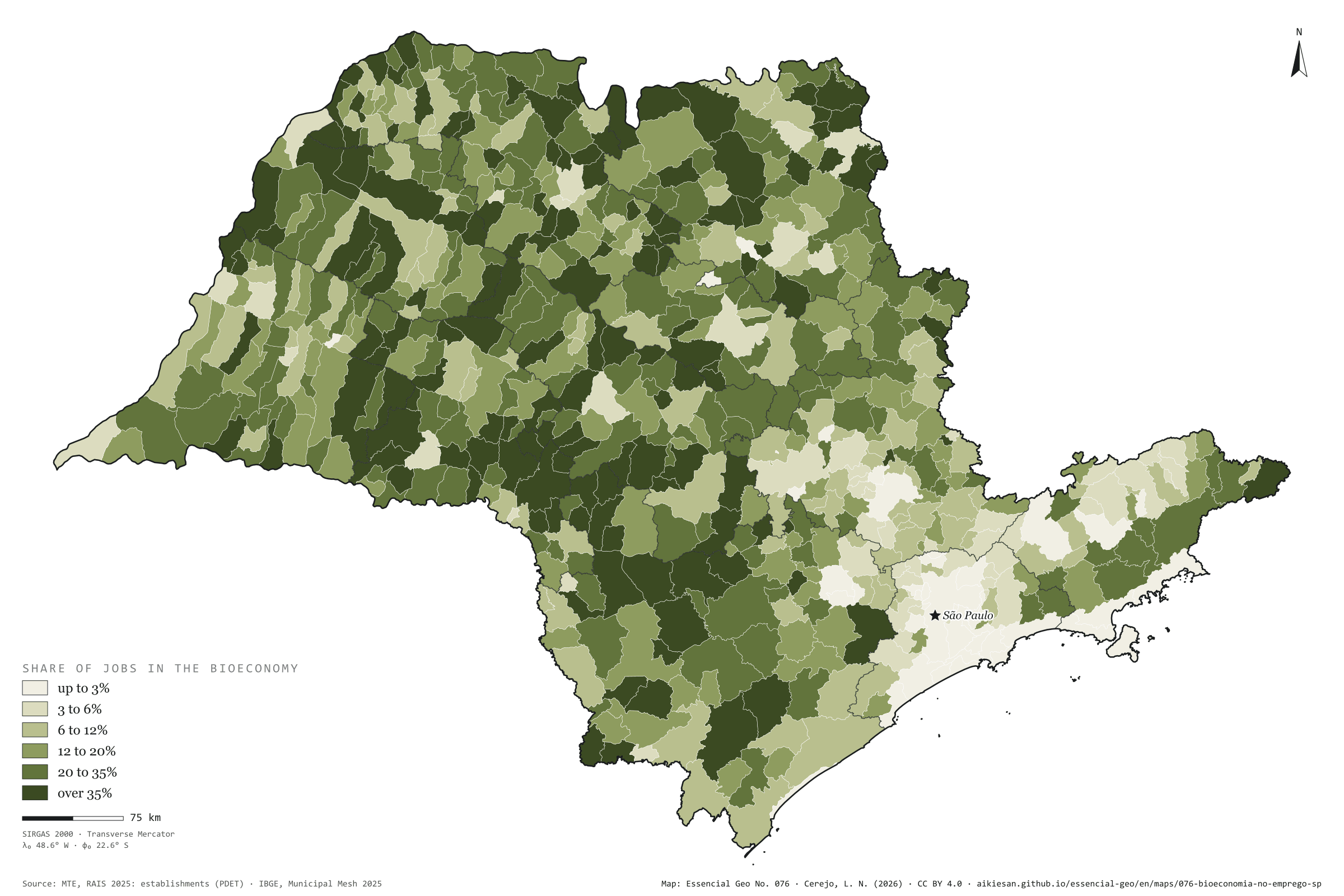
The map without a frame, with legend, scale, reference system and credit written on it: ready for papers, lectures and slides. In two versions: with the basemap (neighbours and sea) or only the mapped area, on white.

Point a camera at it to open this page.

How to cite

Cerejo, L. N. (2026). A bioeconomia no emprego: um em cada quinze empregos formais vem da biomassa [The bioeconomy in jobs: One formal job in fifteen comes from biomass] (Version 1.0.0) [Data set]. Essencial. https://aikiesan.github.io/essencial-geo/en/maps/076-bioeconomia-no-emprego-sp/

How to read this plate area, projection, scale, legend and source
1 Area
São Paulo State (SP) The area the plate covers. Outside it, neighbours and sea are drawn in grey, just for orientation.
2 Coordinates and projection
SIRGAS 2000 (EPSG:4674) The layers are in SIRGAS 2000; the drawing’s projection is written in the colophon at the foot of the panel.
3 Scale
Graphic scale bar in the panel The scale bar is true on the central meridian; away from it, measured distances vary a little.
4 Legend and layers
3 layers in the GeoPackage · polygon Read the legend before the map: it tells you whether a colour is a rate or a class, and whether a circle is a total.
5 Sources
MTE/PDET (2025); JRC (European Commission) (2024); IBGE (2025) Every figure comes from a public source, with its year. The data sheet gives each one’s address.

Download

Layers, table and figures, under CC BY 4.0. Cite with the DOI.

Full record and citation

Method notes · No. 076

The bioeconomy in formal employment across São Paulo’s municipalities

Português · English

Plate No. 076, the first of five in the collection The bioeconomy at work. Which bioeconomy it is, municipality by municipality, is on plate 077.

In Europe, the JRC and the nova-Institute have measured since 2017 the jobs and value added of the bioeconomy in each country and each region (NUTS 2), in a public dashboard. Brazil has no such account, by state or by municipality. This collection applies the same sector scope to RAIS 2025, which records the formal jobs of every establishment.

What the files contain

Layer (GPKG)GeometryContent
municipiospolygon645 municipalities: vinculos, estab, bio, pct_bio, ql_bio (location quotient against Brazil), the segments agro, alimentos, madeira, fibras, biocombustiveis and the dominante; the industries of plate 078 (ger, g_*, g_dominante), the waste of plate 080 (res_*, res_10mil), the CP2B potential (biometano, biometano_urbano, biometano_cana, biometano_pecuaria) and pessoas
regioes_intermediarias, limite_estadualpolygonreference

The GPKG is the same for all five plates, with the QGIS styles pct_bio, dominante, g_dominante and res_10mil. The CSV has the municipal table, without geometry.

Method

  1. RAIS 2025, establishment file (RAIS ESTAB PUB): active jobs on 31/12/2025 by CNAE 2.0 subclass and municipality; establishments filing a nil return count as zero. Brazil’s total, 59,970,945 jobs, matches the stock in the official RAIS 2025 presentation.
  2. Bioeconomy, within the JRC scope: the sectors that produce biomass (CNAE divisions 01 to 03) and those that wholly convert it: food, drink and tobacco (10 to 12); wood, paper and wooden furniture (16, 17 and 3101-2); natural fibres and leather (13.11, 13.12, 13.21, 13.22 and 15.10); and biofuels (19.31 and 19.32).
  3. Share = bioeconomy jobs over all active jobs in the municipality, in six classes closed on the right: up to 3%, 3 to 6%, 6 to 12%, 12 to 20%, 20 to 35% and over 35%.

Limitations

  • The JRC also counts a fraction of the partly bio-based sectors, such as chemicals, plastics and pharmaceuticals, by the biomass share of their inputs. Without those coefficients for Brazil they are left out, so the bioeconomy here is a floor.
  • RAIS counts formal jobs only. In farming, where informal and family work weigh more, the real bioeconomy is larger than the map shows.
  • A job sits in the municipality of the reporting establishment: a firm with several sites that reports everything through its head office moves the jobs there.

View this map’s folder on GitHub

Technical record

Technical record · No. 076

The bioeconomy in jobs

At a glance

Bioeconomy jobs by the bioeconomy’s share of the municipality’s jobs (jobs)
  • up to 3% 12.6%
  • 3 to 6% 10.4%
  • 6 to 12% 15.8%
  • 12 to 20% 14.9%
  • 20 to 35% 20.5%
  • over 35% 25.9%
Formal jobs in the bioeconomy

6.5 %

1.05 million jobs; Brazil, 7.9%

SP’s share of Brazil’s formal bioeconomy

22 %

of 4.74 million jobs

Layers

  • municipios polygon 645 municipalities: jobs, bioeconomy jobs by segment, share and location quotient, organic-waste-generating industries, waste and sewage, CP2B biomethane potential and population
  • regioes_intermediarias polygon 11 intermediate geographic regions
  • limite_estadual polygon State boundary

Metadata

Extent
São Paulo State (SP)
CRS / Projection
SIRGAS 2000 (EPSG:4674)
EPSG:4674
Software
Node.js · d3-geo · QGIS
Method
Active jobs on 31/12/2025 in the bioeconomy’s CNAE subclasses (farming, fishing and forestry; food, drink and tobacco; wood, paper and wooden furniture; natural fibres and leather; biofuels), within the European JRC scope, over all active jobs in each municipality, in six classes.
Version
v1.0.0
Licence
CC BY 4.0
DOI
being registered on Zenodo

Downloads

Figure to reuse

The map without a frame, with legend, scale, reference system and credit written on it: ready for papers, lectures and slides. In two versions: with the basemap (neighbours and sea) or only the mapped area, on white.

Point a camera at it to open this page.

How to cite

Cerejo, L. N. (2026). A bioeconomia no emprego: um em cada quinze empregos formais vem da biomassa [The bioeconomy in jobs: One formal job in fifteen comes from biomass] (Version 1.0.0) [Data set]. Essencial. https://aikiesan.github.io/essencial-geo/en/maps/076-bioeconomia-no-emprego-sp/

100%