The organic-waste factories
Mills, slaughterhouses, dairies, juice plants and breweries: where industry leaves organic waste
Record, downloads and citationSome industries leave organic waste in volume: vinasse, filter cake and bagasse at the mills; blood, rumen contents and fatty effluent at slaughterhouses; whey at dairies; pulp and peel at juice plants; yeast and spent grain at breweries. In São Paulo, 364,647 formal jobs are in these industries, in 3,692 establishments and 531 municipalities. Sugar and ethanol account for 46%; slaughter, 23%. The capital has the most jobs, 16,133, split between dairy, oils, slaughter and drinks. Inland the mill rules: in Guaíra, 87% of the 7,588 jobs are in sugar and ethanol; Sertãozinho and Araras follow close behind. Slaughter leads in 124 municipalities, the mills in 116 and dairies in 89. CP2B already counts cane residues; the effluent of the other industries is left out. Third plate of the collection “The bioeconomy at work”.
Technical record · downloads · citation
At a glance
- Sugar and ethanol 45.5%
- Slaughter 23%
- Drinks 9.1%
- Grain and feed 8.8%
- Dairy 6.4%
- Fruit and juice 4.9%
- Oils 2.3%
3,692 establishments
Layers
- municipios polygon 645 municipalities: jobs and establishments in generating industries, by branch, and the dominant branch (same GPKG as plate 076)
- regioes_intermediarias polygon 11 intermediate geographic regions
- limite_estadual polygon State boundary
Metadata
- Sources
- MTE/PDET — RAIS 2025: establishments (RAIS ESTAB PUB), active jobs on 31/12 by CNAE 2.0 subclass and municipality (2025)
IBGE — Municipal Mesh 2025 (2025) - Extent
- São Paulo State (SP)
- CRS / Projection
- SIRGAS 2000 (EPSG:4674)
EPSG:4674 - Software
- Node.js · d3-geo · QGIS
- Method
- Active jobs on 31/12/2025 in seven industrial branches that generate organic effluent and waste in volume (slaughter, dairy, fruit and juice, sugar and ethanol, oils, drinks, grain and feed), by CNAE class and municipality; circle proportional to the total, coloured by the branch with most jobs.
- Version
- v1.0.0
- Licence
- CC BY 4.0
- DOI
- being registered on Zenodo
Downloads
- GPKG Municipalities with the RAIS bioeconomy and the CP2B potential, SIRGAS 2000, with QGIS styles (.gpkg) 4.5 MB
- CSV Municipal table (.csv) 90 kB
- SVG Vector plate, for printing (.svg) 2.2 MB
- PNG Plate (PNG, 2400 px) (.png) 0.3 MB

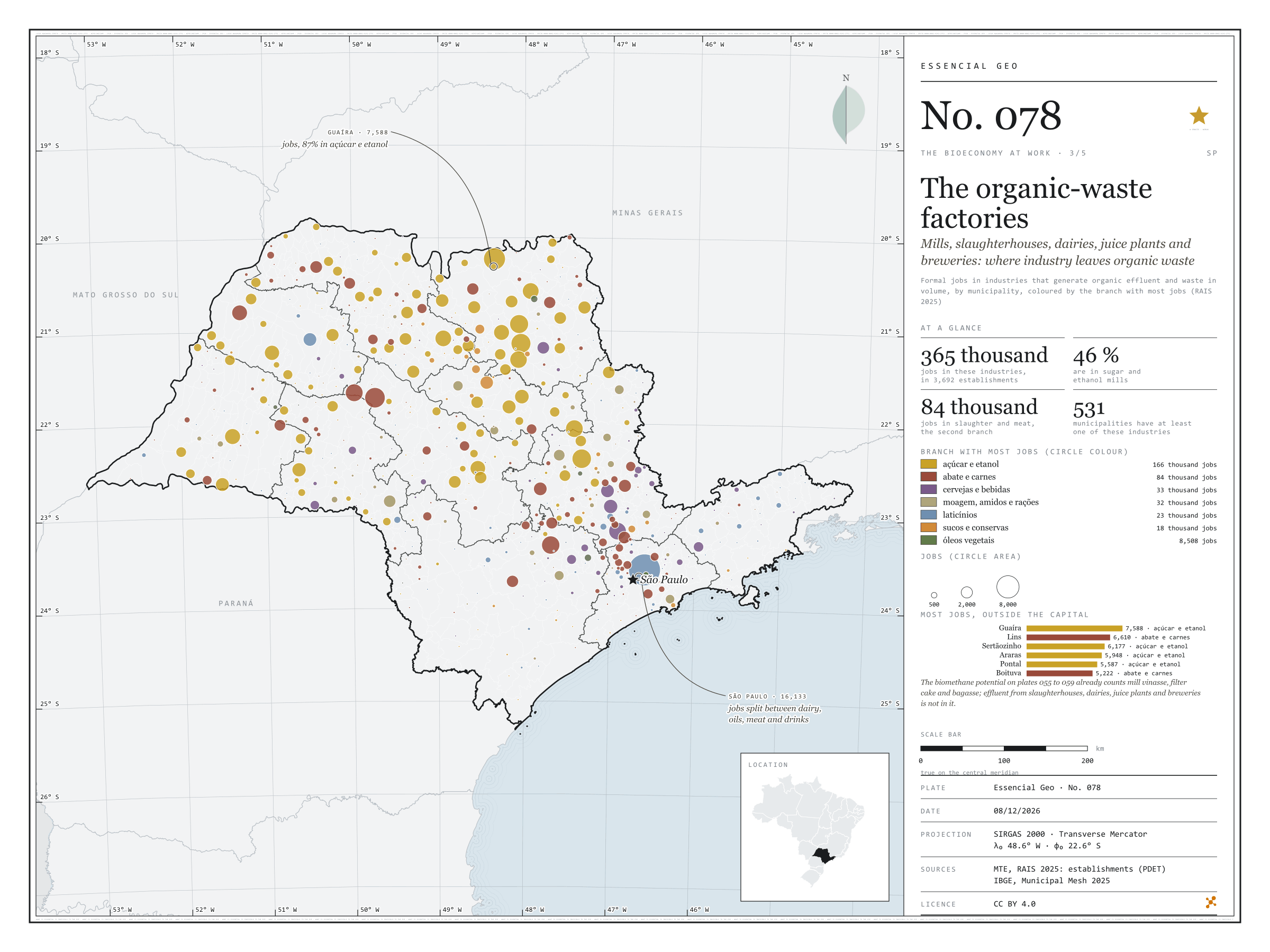
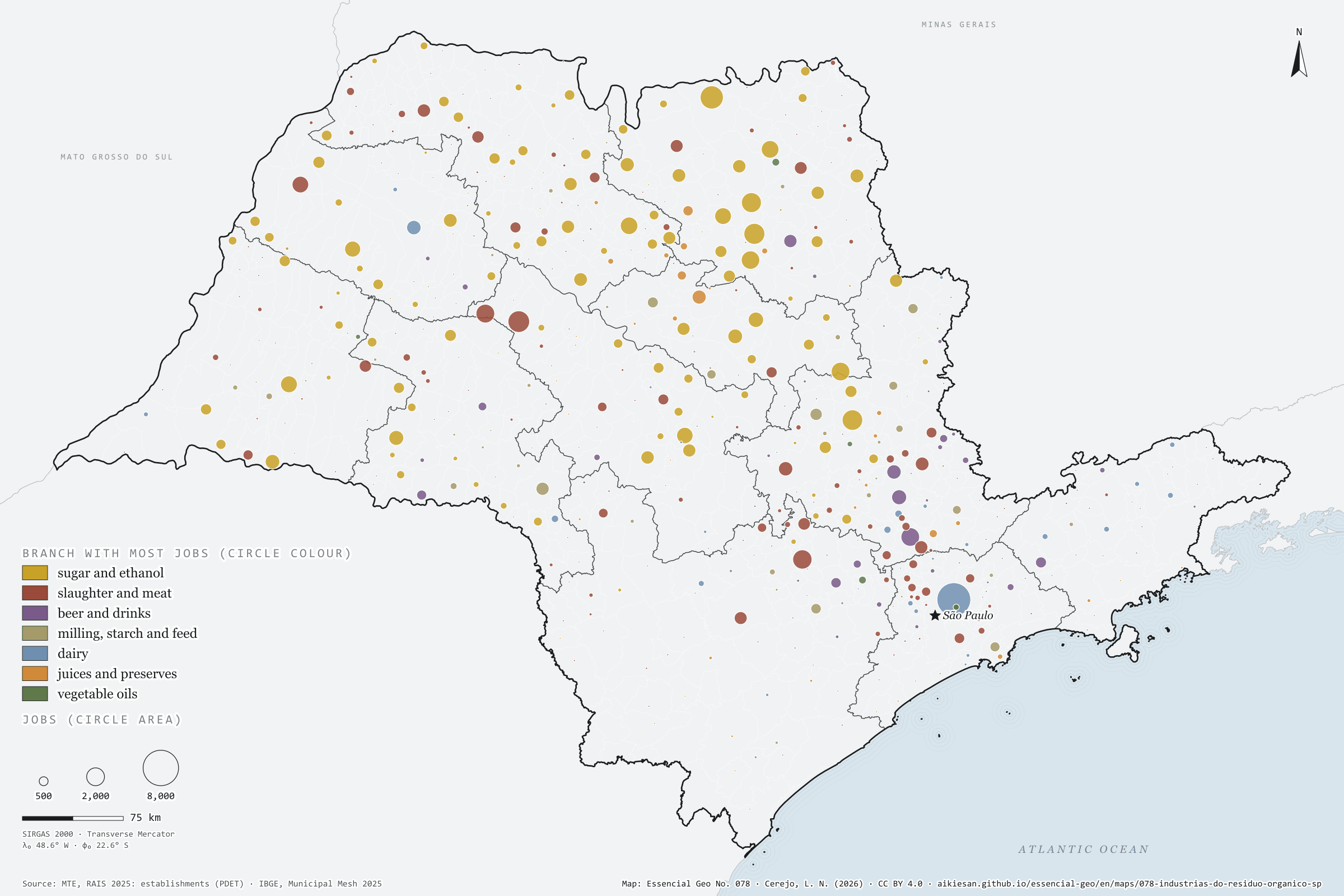
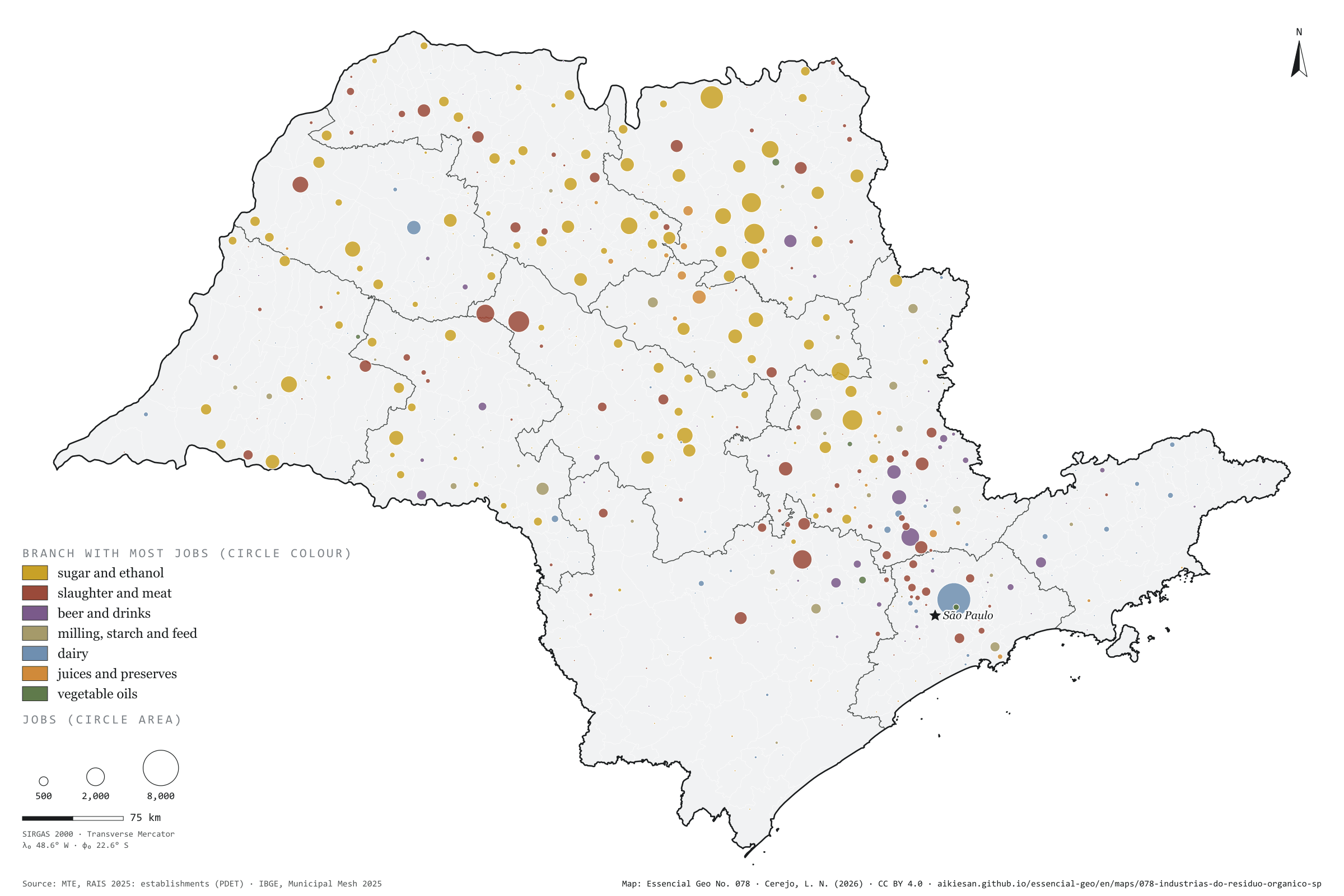
Figure to reuse
The map without a frame, with legend, scale, reference system and credit written on it: ready for papers, lectures and slides. In two versions: with the basemap (neighbours and sea) or only the mapped area, on white.
With basemap (PNG) Without basemap (PNG) QR code (SVG)
Point a camera at it to open this page.
How to cite
CEREJO, Lucas Nakamura. As fábricas do resíduo orgânico: usinas, frigoríficos, laticínios, sucos e cervejarias: onde a indústria deixa resíduo orgânico. Versão 1.0.0. [S. l.]: Essencial, 2026. Conjunto de dados. Disponível em: https://aikiesan.github.io/essencial-geo/en/maps/078-industrias-do-residuo-organico-sp/. Acesso em: 10 nov. 2026.
Cerejo, L. N. (2026). As fábricas do resíduo orgânico: usinas, frigoríficos, laticínios, sucos e cervejarias: onde a indústria deixa resíduo orgânico [The organic-waste factories: Mills, slaughterhouses, dairies, juice plants and breweries: where industry leaves organic waste] (Version 1.0.0) [Data set]. Essencial. https://aikiesan.github.io/essencial-geo/en/maps/078-industrias-do-residuo-organico-sp/
@dataset{cerejo2026_industrias_do_residuo_organico_sp,
  author    = {Cerejo, Lucas Nakamura},
  title     = {As fábricas do resíduo orgânico: Usinas, frigoríficos, laticínios, sucos e cervejarias: onde a indústria deixa resíduo orgânico},
  year      = {2026},
  publisher = {Essencial},
  version   = {1.0.0},
  url       = {https://aikiesan.github.io/essencial-geo/en/maps/078-industrias-do-residuo-organico-sp/},
  language  = {portuguese},
  note      = {English title: The organic-waste factories: Mills, slaughterhouses, dairies, juice plants and breweries: where industry leaves organic waste. Licence CC BY 4.0}
}