Who treats the waste
Urban waste is everywhere; those who treat it are in few places
Record, downloads and citationSão Paulo’s organic rubbish, sewage sludge and prunings would yield 621,000 m³ of biomethane a day at CP2B’s accessible level, and that matter is in every town. Those who treat it are not. Only 71 of the 645 municipalities have formal jobs in waste treatment and disposal, landfills, composting and biogas plants: 7,555 in the state, against 52,000 in collection. The capital has 23% of urban biomethane and 1,861 of those jobs; São José dos Campos, Arujá and Caieiras come next. Yet 44% of urban biomethane lies in municipalities with no treatment jobs at all: Piracicaba has 13,000 m³ a day and none; São José do Rio Preto, 12,000 and none. There, waste travels to a landfill in another municipality or is handled by the council, outside the private count. Fifth and last plate of the collection “The bioeconomy at work”.
Technical record · downloads · citation
At a glance
- Collection 67.8%
- Materials recovery 15.8%
- Treatment and disposal 9.9%
- Sewage 6.4%
44 %
Layers
- municipios polygon 645 municipalities: jobs in sewage, collection, treatment and recovery, jobs per 10,000 people and urban biomethane potential (same GPKG as plate 076)
- regioes_intermediarias polygon 11 intermediate geographic regions
- limite_estadual polygon State boundary
Metadata
- Sources
- MTE/PDET — RAIS 2025: establishments (RAIS ESTAB PUB), active jobs on 31/12 by CNAE 2.0 subclass and municipality (2025)
CP2B (Unicamp) — biogas and biomethane potential by municipality, method v5.1 (2026)
IBGE — 2022 Population Census: municipal population (2022)
IBGE — Municipal Mesh 2025 (2025) - Extent
- São Paulo State (SP)
- CRS / Projection
- SIRGAS 2000 (EPSG:4674)
EPSG:4674 - Software
- Node.js · d3-geo · QGIS
- Method
- Urban-waste biomethane potential by municipality (CP2B v5.1, level N4, reference scenario: organic waste, sewage sludge and prunings), in five classes, and circles proportional to active jobs on 31/12/2025 in waste treatment and disposal (CNAE 38.21 and 38.22, RAIS 2025).
- Version
- v1.0.0
- Licence
- CC BY 4.0
- DOI
- being registered on Zenodo
Downloads
- GPKG Municipalities with the RAIS bioeconomy and the CP2B potential, SIRGAS 2000, with QGIS styles (.gpkg) 4.5 MB
- CSV Municipal table (.csv) 90 kB
- SVG Vector plate, for printing (.svg) 2.2 MB
- PNG Plate (PNG, 2400 px) (.png) 0.3 MB

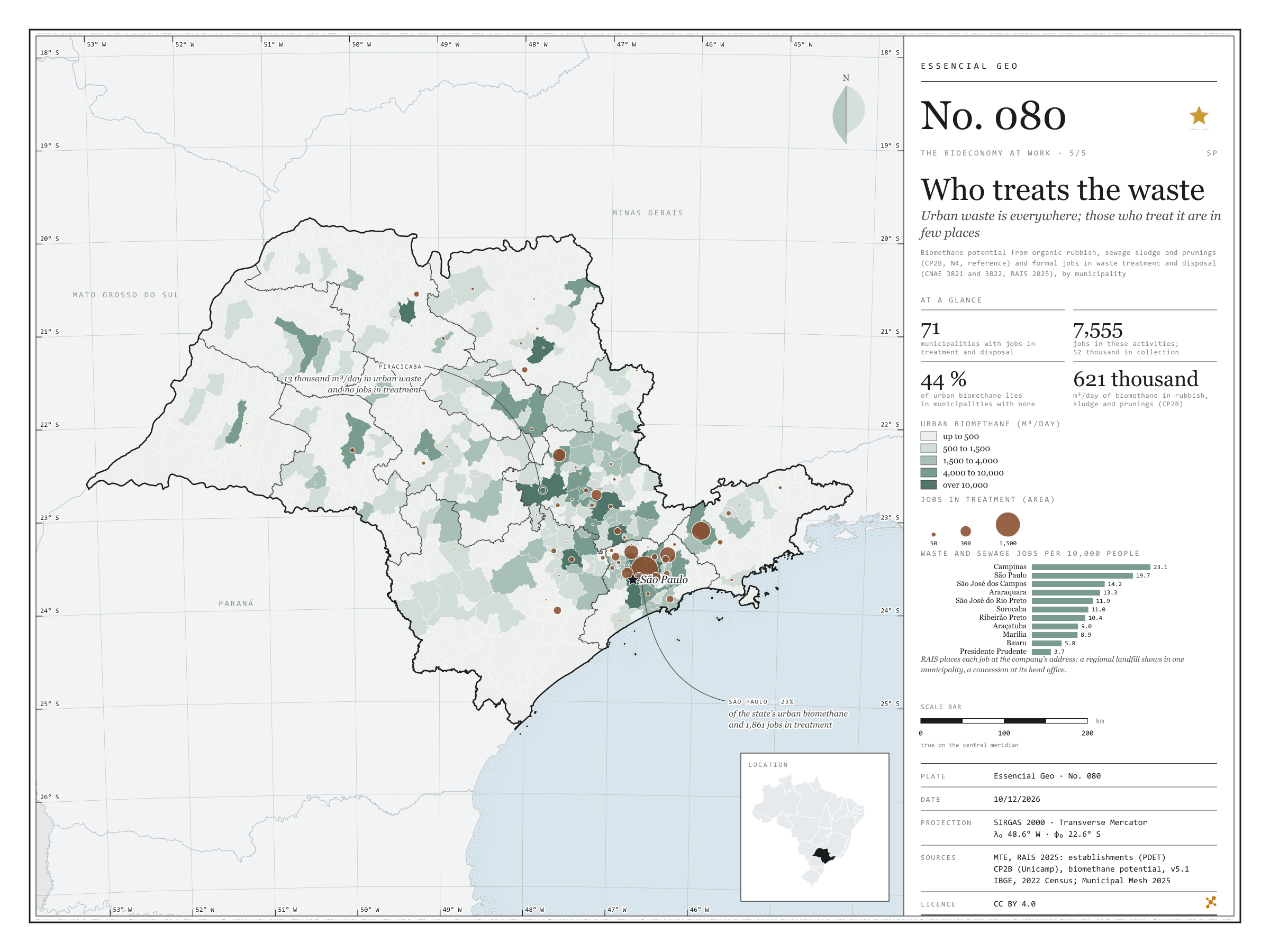
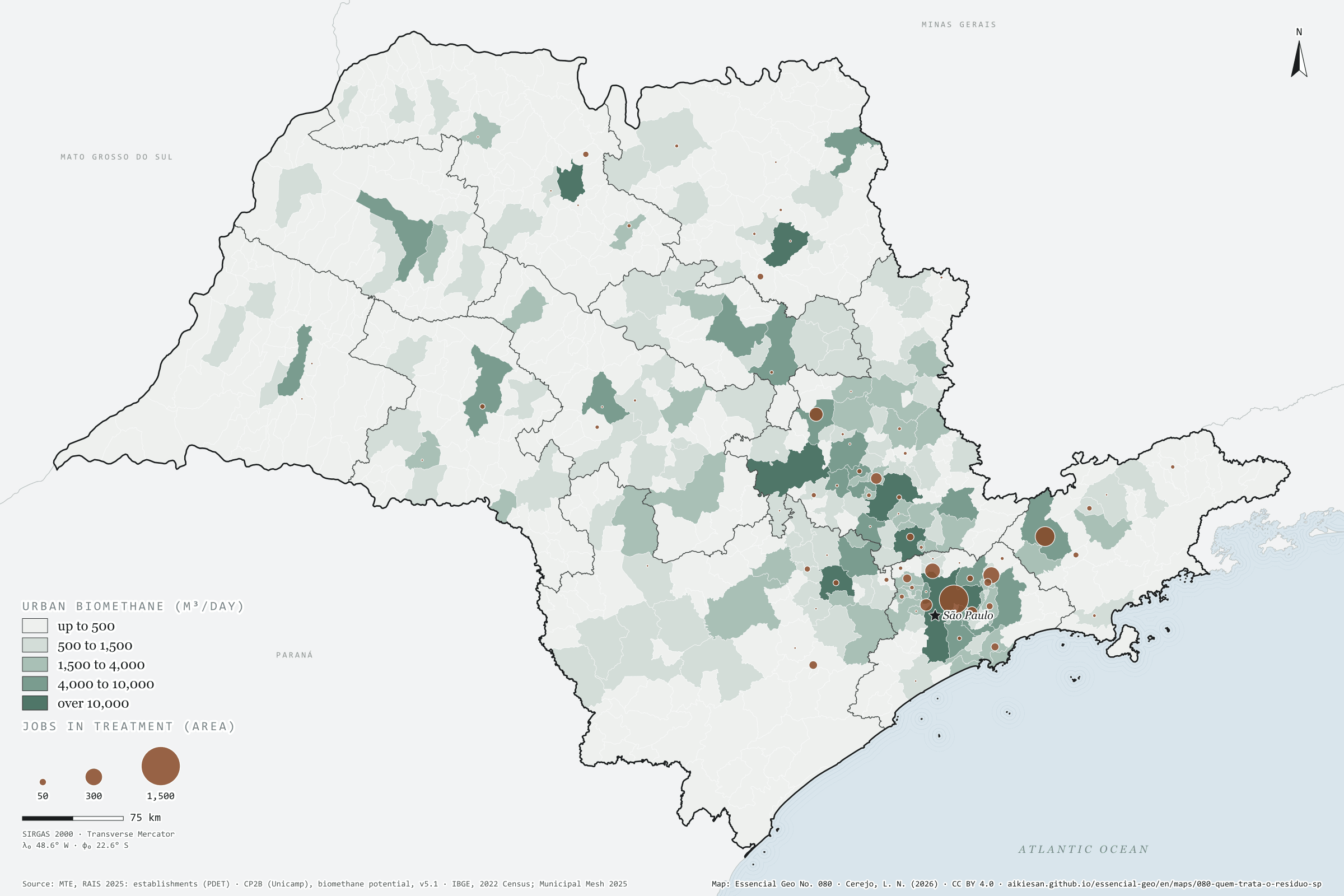
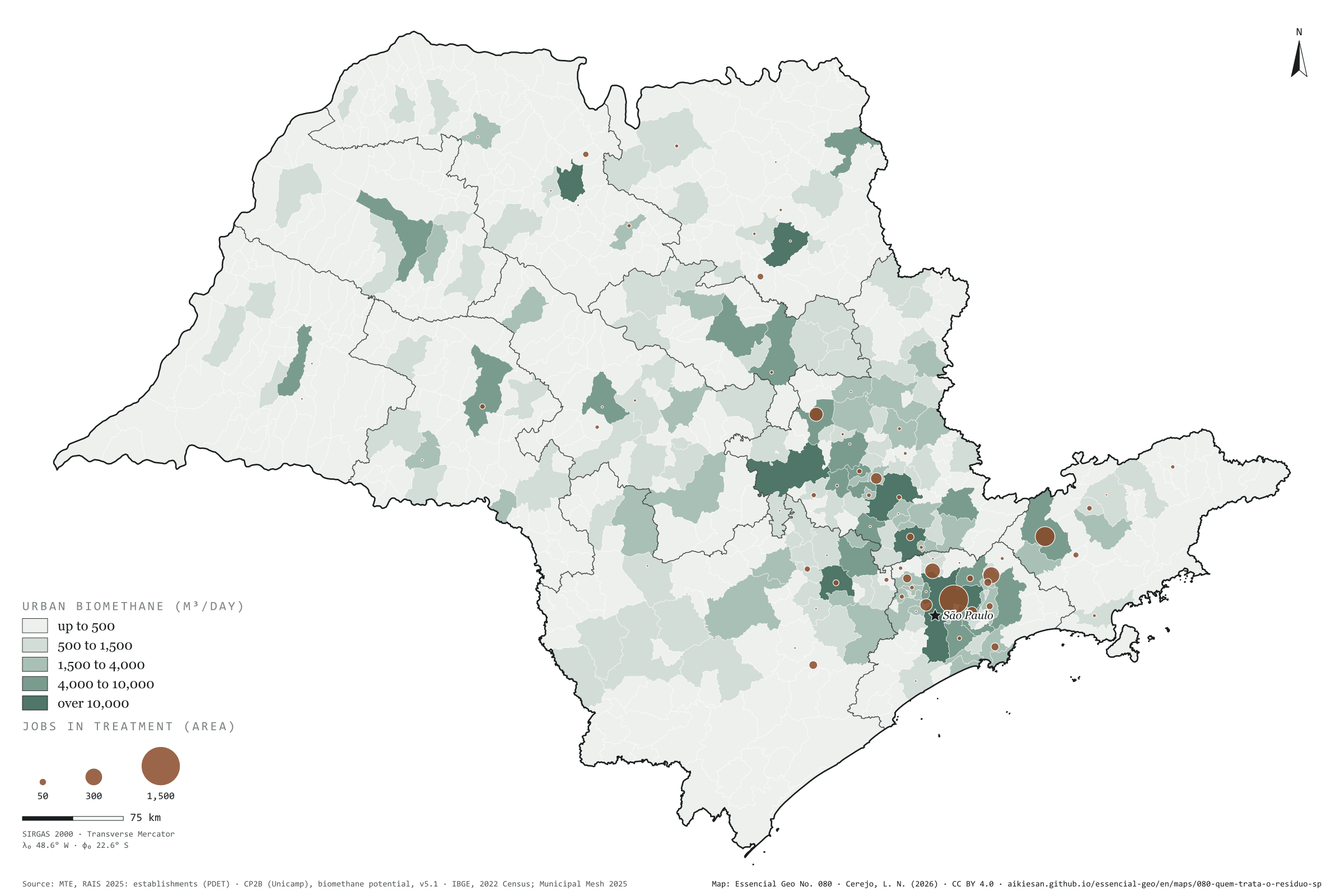
Figure to reuse
The map without a frame, with legend, scale, reference system and credit written on it: ready for papers, lectures and slides. In two versions: with the basemap (neighbours and sea) or only the mapped area, on white.
With basemap (PNG) Without basemap (PNG) QR code (SVG)
Point a camera at it to open this page.
How to cite
CEREJO, Lucas Nakamura. Quem trata o resíduo: o resíduo urbano está em toda parte; quem o trata, em poucos lugares. Versão 1.0.0. [S. l.]: Essencial, 2026. Conjunto de dados. Disponível em: https://aikiesan.github.io/essencial-geo/en/maps/080-quem-trata-o-residuo-sp/. Acesso em: 10 nov. 2026.
Cerejo, L. N. (2026). Quem trata o resíduo: o resíduo urbano está em toda parte; quem o trata, em poucos lugares [Who treats the waste: Urban waste is everywhere; those who treat it are in few places] (Version 1.0.0) [Data set]. Essencial. https://aikiesan.github.io/essencial-geo/en/maps/080-quem-trata-o-residuo-sp/
@dataset{cerejo2026_quem_trata_o_residuo_sp,
  author    = {Cerejo, Lucas Nakamura},
  title     = {Quem trata o resíduo: O resíduo urbano está em toda parte; quem o trata, em poucos lugares},
  year      = {2026},
  publisher = {Essencial},
  version   = {1.0.0},
  url       = {https://aikiesan.github.io/essencial-geo/en/maps/080-quem-trata-o-residuo-sp/},
  language  = {portuguese},
  note      = {English title: Who treats the waste: Urban waste is everywhere; those who treat it are in few places. Licence CC BY 4.0}
}